

Blog / Automotive
AutomotiveBulk Price Amendments: How to Update Part Costs and Supplier Prices After a Raw Material Change

Cost It Right
Oct 28, 2026
Listen to this article
AI narration • 17:13 listen
0:00 / 17:13
A bulk price amendment is a planned, controlled change to the cost and price of many parts at the same time, triggered by one input that has moved. The input is usually a raw material such as steel, aluminium or copper, but it can also be an exchange rate, an energy tariff or an engineering change.
When HR coil goes up 6% in a month, the cost of every pressed, machined and fabricated part that uses it moves with it. Purchase has to revise supplier prices, costing has to revise part costs, and sales has to revise quotes. Done part by part, this takes weeks and invites errors. Done in bulk, with the right controls, it takes a clear method and one source of truth.
This guide explains what triggers an amendment, how to calculate the change correctly, why an ERP mass update or an Excel sheet falls short, and a 7-step process a plant can follow. It includes a worked example in rupees.
In short
A bulk price amendment changes many part costs and prices together after one input moves.
Only the affected share of the price changes. A 6% steel rise on a part where steel is 28% of the price moves that price by 1.68%, not 6%.
The core formula is: new material cost = old material cost × current index ÷ base index.
A safe process has seven steps: scope, formula, simulate, approve, publish, reconcile, audit.
Price decreases need the same discipline as price increases.
What is a bulk price amendment?
A bulk price amendment is one governed change that updates the cost, and then the price, of every part affected by a movement in one input. "Bulk" means the change is applied to a group of parts, suppliers or customers together instead of one record at a time. "Amendment" means the earlier price stays on record with its dates, and the new price takes over from a stated effective date.
Three things separate an amendment from a casual price edit:
It has a reason, such as an index movement or a contract clause.
It has an effective date, so invoices before and after that date use the right price.
It leaves a trail: who approved it, what the old value was and what the new value is.
Our post on cost amendments in automotive explains the layers of cost where amendments originate. This post goes one step further and shows how to carry the change out.
What triggers a bulk price amendment?
Most plants see the same seven triggers again and again.
Raw material index movement. Steel, aluminium, copper and resin indices are published at fixed intervals. Many supply agreements tie the price to one of them.
Price variation clauses. A raw material price variation (RMPV) or price adjustment clause links the part price to index movement through a base index, a review period and often a cap and a floor. Our guide to the price adjustment clause for raw material covers the clause itself.
Engineering changes. A change in gross weight, material grade or process alters the cost of every part in the family.
Exchange rate. Imported components and inputs priced in dollars or euros move with the rupee.
Energy and conversion cost. A power tariff change or a wage revision shifts the machine hour rate. See how it is built in machine hour rate calculation.
Annual price reductions. Long-term agreements often carry a yearly reduction that has to be applied across many parts together.
Norm and yield changes. A revised scrap allowance, yield or packaging norm changes cost without any change in the market.
If you are still deciding which index to follow, start with raw material price volatility, which explains why the choice of index matters as much as the formula.
How do you calculate the price change?
The most common mistake is applying the full percentage move to the full price. Only the share of the price that depends on the changed input should move.
The formula
Find the material cost: gross weight × material rate per kg.
Apply the index ratio: new material cost = old material cost × current index ÷ base index.
Find the change: new material cost minus old material cost.
Find the new price: old price plus the change.
Whether overheads and margin are applied on top of the material change depends on your contract. Many agreements adjust only the material component, so confirm what your own clause says before you build the calculation.
Worked example for one part
This example is illustrative. Take a pressed bracket supplied at Rs 200.00 per piece.
Item | Value |
|---|---|
Current part price | Rs 200.00 |
Steel gross weight | 0.8 kg |
Steel rate | Rs 70 per kg |
Material cost | Rs 56.00 (28% of the price) |
Base index | 100 |
Current index | 106 (a 6% rise) |
New material cost | Rs 56.00 × 10⁶ ÷ 100 = Rs 59.36 |
Increase | Rs 3.36 |
New part price | Rs 203.36 |
Price movement | 1.68% |
Annual volume | 1,20,000 pieces |
Annual effect | Rs 3.36 × 1,20,000 = Rs 4,03,200 |
A 6% steel rise became a 1.68% price rise, because steel is only 28% of this price. Applying 6% to the full Rs 200 would have given Rs 12 per piece, which is more than three times the right figure and Rs 14,40,000 a year instead of Rs 4,03,200.
The same change across a group of parts
Now apply the same 6% steel rise to three parts that use the same grade.
Part | Current price (Rs) | Steel cost (Rs) | Increase (Rs) | New price (Rs) | Price movement | Annual volume | Annual effect (Rs) |
|---|---|---|---|---|---|---|---|
Bracket | 200.00 | 56.00 | 3.36 | 203.36 | 1.68% | 1,20,000 | 4,03,200 |
Cover plate | 150.00 | 35.00 | 2.10 | 152.10 | 1.40% | 80,000 | 1,68,000 |
Shaft | 420.00 | 147.00 | 8.82 | 428.82 | 2.10% | 30,000 | 2,64,600 |
Total | 8,35,800 |
Same index move, three different price movements. Weights here are gross weights, so scrap allowance is already inside them. If your supplier credits scrap recovery, include that in the calculation. Three parts are easy to do by hand. Three thousand parts, each with its own weight, supplier and effective date, is where manual methods start to fail.
Why are an ERP mass update and Excel not enough?
ERP systems such as SAP include mass change functions for purchase prices and info records. A buyer can apply a percentage to many records, set a validity period and run a test before saving. That is useful, and plants should keep using it for the final purchase price record.
What a standard mass change does not do is explain the price. It updates the record. It does not rebuild the cost breakup behind it:
The material, conversion, overhead and margin lines are not recalculated.
You do not see the effect on an assembly or a finished good before you commit.
The reason for the change, the approval and the comparison with the earlier costing usually sit somewhere else, in mails and files.
Check what your own ERP configuration supports, because setups differ.
Excel is where most plants do the thinking, and its flexibility is also its weakness:
Formulas break when someone inserts a row or links to the wrong file.
Several versions circulate and nobody is sure which one was approved.
There is no automatic record of who changed what and when.
The effect on finished goods needs a separate manual roll-up through the BOM.
Neither tool is wrong. The gap is in the middle: calculating the change on the cost breakup, seeing the impact up to the finished good, getting it approved and then releasing the approved values to the ERP. A structured costing sheet for an auto component is the foundation for that middle step.
How to run a bulk price amendment in 7 steps
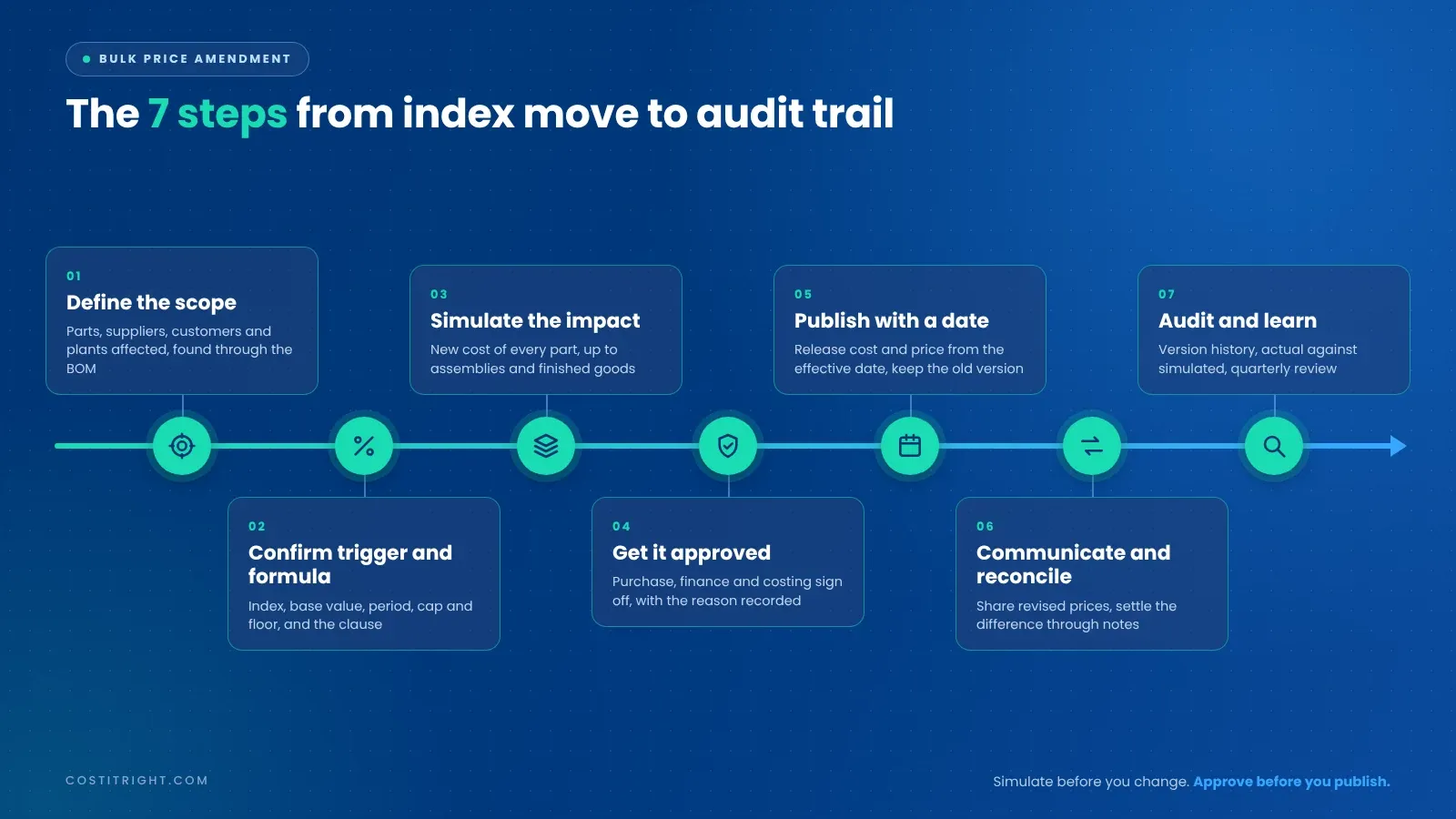
Define the scope. List the parts, suppliers, customers and plants affected. Use the BOM to find every part that uses the material, including child parts inside assemblies. Decide the cut-off date for the amendment.
Confirm the trigger and the formula. Record the index source, the base and current values, the review period, any cap and floor, and the clause that allows the change. If the numbers cannot be traced to a clause or an agreed index, stop here.
Simulate before you change anything. Calculate the new cost of every affected part, roll it up to assemblies and finished goods, and compare it with the current cost. Flag the parts where margin falls below your threshold and the customers whose contracts fix the price.
Get it approved. Route the simulation to purchase, finance and the costing head. Add sales for any customer-facing price. Record the reason with the approval.
Publish with an effective date. Release the approved cost, supplier price and quote price from the stated date. Invoices before that date keep the old price. Keep the previous version on record.
Communicate and reconcile. Share the revised price with suppliers and customers. For material received or invoiced between the effective date and the release date, settle the difference through supplementary invoices or credit notes. How these are raised and taxed is a matter for your finance team and tax adviser, so confirm the treatment with them.
Audit and learn. Keep the version history, compare actual variance with the simulated variance, and review the process every quarter. When a supplier sends an increase request, check it against your own calculation first. Our guide to supplier quote analysis shows how to test a quote line by line.
What happens when the price goes down?
Amendments run in both directions. When the index falls, the same formula applies.
Using the bracket from earlier, suppose the steel index falls 4%, from 100 to 96.
New material cost: Rs 56.00 × 96 ÷ 100 = Rs 53.76
Change: minus Rs 2.24
New part price: Rs 197.76, which is 1.12% lower
Annual effect on 1,20,000 pieces: Rs 2,68,800
Decreases are missed more often than increases, for a simple reason. An increase arrives as a request from a supplier. A decrease arrives as nothing, and nobody asks for it. Three habits fix this:
Review on a fixed cycle, monthly or quarterly, whether or not anyone has asked.
Write clauses that work both ways, so a fall in the index is passed on with the same formula as a rise.
Agree a cap and a floor. A cap limits the largest increase in a period and a floor limits the largest decrease. Apply both in the simulation so nobody is surprised at the invoice.
To anticipate the next move instead of reacting to it, read how AI raw material cost forecasting can inform the review cycle.
How does Cost It Right handle bulk price amendments?
Cost It Right is built around the cost breakup, so an amendment starts where the change actually happens, at the master. The flow follows the seven steps above:
Raw material indexation. Link a material to an external index, and control the effective date and the review periodicity. Price history is kept for every change.
Bulk change by Excel upload. Prepare the revised rates for many items and upload them in one go. The upload goes into the tool, so there is no sheet to keep circulating.
Simulation on a master change. Before a revised rate is saved, see its impact on dependent parts, assemblies and finished goods.
Approval workflow. The change goes through the approval route you define before it takes effect.
Version history and audit trail. Every costing keeps its versions, and every change records who made it and when.
Cost Variance and Cost Movement reports. See how cost moved between versions and where the movement came from.
ERP sync. Approved data is passed on to your ERP, so the purchase price record follows the approved costing.
The result is that purchase, costing and finance work from the same numbers, and the question "why did this price change" has a recorded answer. For the wider picture of keeping raw material data under control, see why raw material tracking software is essential for manufacturers.
Which KPIs show that the process works?
KPI | What it tells you | How to measure |
|---|---|---|
Amendment cycle time | How fast the plant reacts to a trigger | Days from the index move or supplier notice to the published effective date |
On-time amendment rate | Whether affected parts are updated when they should be | Parts amended by their effective date ÷ parts affected |
Margin leakage | Money lost when an increase is not passed on in time | Eligible increase per piece × volume for the delay period |
Provision accuracy | How close the quarter-end provision was to the final settlement | Provisioned amount compared with settled amount |
Disputed notes | Quality of the calculation and the paperwork | Count of supplementary invoices or credit notes queried |
Decrease pass-back rate | Whether falls in price are captured as well as rises | Eligible decreases applied ÷ eligible decreases identified |
What mistakes should you avoid?
Applying the full percentage to the full price. Move only the share of the price that depends on the input.
Using net weight instead of gross weight. Scrap and yield belong in the calculation.
Skipping the effective date, or back-dating a price without agreement from the other party.
Forgetting child parts. A material change inside a sub-assembly has to reach the finished good.
Ignoring decreases. The process should run on a calendar, not on complaints.
Keeping the working in loose Excel copies. Without version control, nobody can prove which sheet was approved.
Skipping approval for small changes. A 1% change across thousands of parts is not small.
Leaving out the cap and the floor. Without them, a spike in the index flows straight into your price.
See a bulk price amendment on your own parts
The fastest way to judge a method is to run it on your own data. Share a sample of your parts and a recent material price change, and see how Cost It Right simulates the impact up to finished goods, routes it for approval and keeps the version history.
FAQs
What is a bulk price amendment?
A bulk price amendment is one governed change that updates the cost and price of many parts together after an input such as a raw material price has moved. It has a reason, an effective date and a recorded approval, and the earlier price stays on record.
How do you calculate a price revision when a raw material index changes?
Multiply the old material cost by the current index and divide by the base index. The difference is the change in price. Only the material share moves. For example, a 6% steel rise on a part where steel is Rs 56 of a Rs 200 price adds Rs 3.36, a 1.68% price rise.
What is the difference between an ERP mass price update and a cost sheet update?
An ERP mass price update changes the price record for many items at once. A cost sheet update recalculates the cost breakup behind the price, including material, conversion, overheads and margin. A sound amendment needs both: the cost update first, then the approved price released to the ERP.
How should a buyer check a supplier's raw material price increase request?
Ask for the index, the base value, the current value and the clause behind the request. Recalculate the change on the material share of the part using gross weight, and compare the result with the supplier's figure. Differences usually come from applying the percentage to the full price.
How do you handle price decreases when the index falls?
Use the same formula as for increases. If the steel index falls from 100 to 96, a Rs 56 material cost becomes Rs 53.76, a reduction of Rs 2.24 per piece. Review on a fixed cycle and use clauses that work both ways, so decreases are passed on without being asked for.
How often should a plant run a bulk price amendment?
Follow the review period in your contracts or index clauses, which is commonly monthly or quarterly. Run an extra amendment when a large event moves an input sharply, such as a material grade change or a major exchange rate shift. Fixed cycles keep decreases from being missed.
Related Articles

Sep 8, 2026 • 12 min read
Raw Material Price Volatility: Causes, Impact, and How to Protect Your Margins
Learn what drives raw material price volatility, how it affects manufacturing margins, and how indexed contracts can help manage commodity price risk.

Aug 20, 2026 • 17 min read
Supplier Quote vs Should-Cost: How Manufacturers Can Find the Real Cost Behind a Price
Know the difference between a supplier quote and should-cost, why supplier prices vary, and how procurement turns that gap into leverage.

Jun 15, 2026 • 9 min read
Why Material Utilization Matters More Than Material Price
Most OEMs focus on steel prices, but material utilization often has a bigger impact on sheet metal component costs. Learn how scrap, nesting, and yield affect profitability.