
Listen to this article
AI narration • 5:04 listen
0:00 / 5:04

<lidata-term-id="2">
<lidata-term-id="3">
<lidata-term-id="39">
<lidata-term-id="4">
<lidata-term-id="5">
<lidata-term-id="6">
<lidata-term-id="1">
Uncategorized Cost engineers in Tier 1 automotive suppliers face a relentless challenge: keeping part costs accurate while managing OEM cost-down pressures. Every day, you’re tasked with analyzing hundreds, or even thousands, of parts, performing should-cost calculations, and negotiating with suppliers to ensure margins are protected. But relying on spreadsheets and disconnected systems slows you down, increases errors, and weakens your ability to respond to OEM requests. A small miscalculation in a BOM can cost millions across production runs, leading to lost margin, delayed approvals, and strained OEM relationships. Cost engineering software changes this dynamic. It automates calculations, centralizes BOM costing, and provides the real-time insights you need to make informed decisions, negotiate confidently, and protect profitability.
Why Manual Costing Puts Margins at Risk
Manual costing methods no longer meet the speed and accuracy demands of modern automotive supply chains. Common challenges that cost engineers often face due to these include:
Time-consuming updates: Updating hundreds of parts can take weeks.
High error risk: Misentered formulas or outdated spreadsheets can cause costly mistakes.
Fragmented data: Information stored across multiple systems makes collaboration difficult.
Weak negotiation leverage: Without verified cost data, suppliers and OEMs hold the upper hand
What is Cost Engineering Software in Automotive?
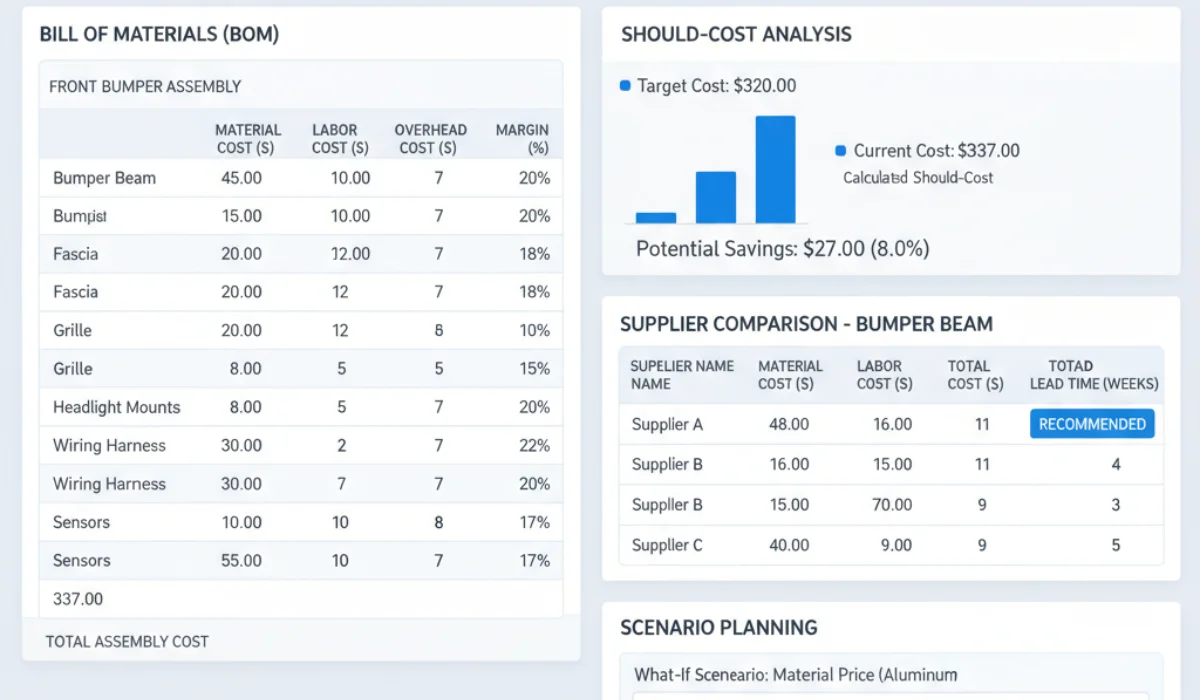
Cost engineering software is a specialized tool designed for cost engineers to calculate, analyze, and optimize part costs accurately and efficiently. Unlike spreadsheets, it integrates with ERP, PLM, and CAD systems to provide centralized, real-time insights across the procurement and engineering teams.
Key Features
Should-Cost Analysis: Estimate the realistic cost of every part based on materials, labor, overhead, and manufacturing processes.
BOM Cost Breakdown: Identify how each component contributes to the total part cost.
Supplier Benchmarking: Compare quotes to internal and industry benchmarks to avoid overpaying.
Scenario Planning: Test cost impacts of design changes, alternative materials, or supplier selection in minutes.
ERP & CAD Integration: Keep data consistent across multiple departments, plants, and systems.
For example, you are calculating the cost of a brake assembly with 50+ components that could take days manually and could include errors. Cost engineering software automates this process and instantly updates costs if raw material prices or labor rates change.
How Cost Engineering Software Solves These Problems

Cost engineering software directly addresses the daily challenges of automotive cost engineers, allowing them to focus on analysis, strategy, and supplier negotiations instead of repetitive number crunching Direct Benefits of Cost Engineering Software
Centralized Cost Data: Consolidates BOMs, supplier quotes, and cost components in a single platform.
Real-Time Updates: Adjusts costs automatically for material, labor, or supplier price changes.
Scenario Planning: Quickly evaluate alternative designs, materials, or suppliers without delaying approvals.
Reliable Should-Cost Analysis: Provides objective benchmarks to support supplier negotiations.
Team Collaboration: Engineers, procurement, and finance work from the same verified data.
Also Read: How to Accurately Estimate the Cost of a New Product
Strategic Advantages for Tier 1 Suppliers
Beyond day-to-day efficiency, cost engineering software provides long-term strategic benefits such as it detects overpriced components before they erode profits, protecting their margins. Also, help them to respond faster to OEM demands and negotiate with objective, verifiable cost data rather than assumptions. Additionally, the software allows them to instantly adjust to raw material price fluctuations and supply chain disruptions.
Operational Benefits of Cost Engineering Software
For cost engineers, the biggest impact is time and focus:
Automation: Reduces repetitive manual calculations.
Consistent Data: All teams work from verified, up-to-date numbers.
Faster Approvals: Costing approvals that used to take days can now be completed in hours.
Higher Job Satisfaction: Engineers spend time on problem-solving and optimization rather than firefighting spreadsheets.
How to Choose the Right Cost Engineering Software
When selecting software, cost engineers should evaluate the analytical depth of the software, whether it can handle complex BOMs or not. It should also work in sync with the various software used by the design, procurement, and finance team. And since cost engineers never work with single part, the software should also support thousands of parts across multiple plants and product lines. It should also be easy to use so that engineers can adopt it rapidly and start working efficiently from day one.
Conclusion
Cost engineers are critical in protecting margins, ensuring fair supplier pricing, and enabling smarter design decisions. Manual costing methods slow this vital work and expose suppliers to margin risk. For Tier 1 automotive suppliers, adopting cost engineering software means the permanent solution of these challenges. It is more than an operational upgrade,it’s a strategic investment that protects margins, increases efficiency, and positions cost engineers as true business partners.
Related Articles
Aug 31, 2026 • 14 min read
RFQ Automation for Manufacturing Buyers: What Most Tools Get Wrong
Most RFQ tools compare supplier quotes to each other, not against a fair cost. What buyer-side RFQ automation for manufacturers actually needs.

Sep 22, 2026 • 9 min read
How to Automate BOM-Level Quoting Without Losing Price Accuracy
How to automate BOM-level quoting for RFQs and why a clean supplier comparison isn't the same as a fair price. A practical guide.
Aug 20, 2026 • 17 min read
Supplier Quote vs Should-Cost: How Manufacturers Can Find the Real Cost Behind a Price
Know the difference between a supplier quote and should-cost, why supplier prices vary, and how procurement turns that gap into leverage.