Table of Contents
Why Do OEMs Focus So Much on Material Price?
The Cost Driver Hidden Behind Every Sheet Metal Component
Where Material Actually Goes During Manufacturing
Why Two Suppliers Quote Different Prices for the Same Component
The Procurement Mistake Most OEMs Make
A Real Costing Scenario: When Expensive Steel Becomes Cheaper
Why Material Utilization Is the Foundation of Should Costing
How OEMs Can Improve Material Utilization
Conclusion
FAQs
Quick Answer
Material utilization often has a bigger impact on sheet metal component costs than material price. A supplier paying a higher steel price can still offer a lower component cost if they achieve better material utilization, lower scrap generation, and higher nesting efficiency. This is why leading OEMs analyze yield, scrap, and utilization alongside raw material prices during supplier evaluations.
What Is Material Utilization?
Material utilization is one of the most important metrics used in sheet metal manufacturing, should costing, procurement cost analysis, and supplier quotation evaluation. While many organizations focus on raw material prices, leading OEMs increasingly analyze utilization, scrap generation, and nesting efficiency to understand the true cost of a component.
Why Do OEMs Focus So Much on Material Price?
Every year, procurement teams spend countless hours negotiating steel prices.
They negotiate annual contracts.
They compare supplier rates.
They track commodity price movements.
They push for every possible reduction in cost per kilogram.
And on the surface, this makes complete sense.
After all, material is often the largest cost element in a sheet metal component. Depending on the product category, material can account for 50% to 70% of the total component cost.
So naturally, most sourcing discussions begin with one question:
“What is the material price?”
But here’s the problem.
While material price is visible, measurable, and easy to compare, it is not always the biggest driver of component cost.
In many cases, two suppliers can purchase the same material from the same market and still arrive at significantly different part costs.
The reason lies in a factor that is rarely discussed during supplier negotiations:
Material utilization.
The reality is simple.
A supplier that uses material efficiently can often produce a lower-cost component than a supplier paying less for steel but generating more waste.
This is one of the most overlooked truths in sheet metal manufacturing and one of the biggest reasons OEMs miss cost-saving opportunities during sourcing.
The Cost Driver Hidden Behind Every Sheet Metal Component
Most procurement professionals think material cost is determined by two factors:
- Material grade
- Material price per kilogram
However, manufacturers know there is a third factor that often matters just as much, if not more:
How efficiently the material is used.
This is known as material utilization.
Material utilization refers to the percentage of purchased material that actually becomes part of the finished component.
The remaining material becomes:
- Scrap
- Trim loss
- Skeleton waste
- Offcuts
- Remnants
And every kilogram of wasted material increases the effective cost of the component.
Think of it this way.
Buying steel is not the goal.
Converting steel into finished parts is the goal.
The supplier who converts more of that steel into sellable parts usually has a cost advantage, regardless of whether they paid slightly more for the raw material.
This is why experienced cost engineers pay close attention to utilization rates before evaluating material prices.
Also Read: The Hidden Cost Drivers in Sheet Metal Components That OEMs Often Miss
Where Material Actually Goes During Manufacturing
One of the biggest misconceptions in sheet metal costing is that a part’s weight determines its material cost.
In reality, the material journey is much more complex.
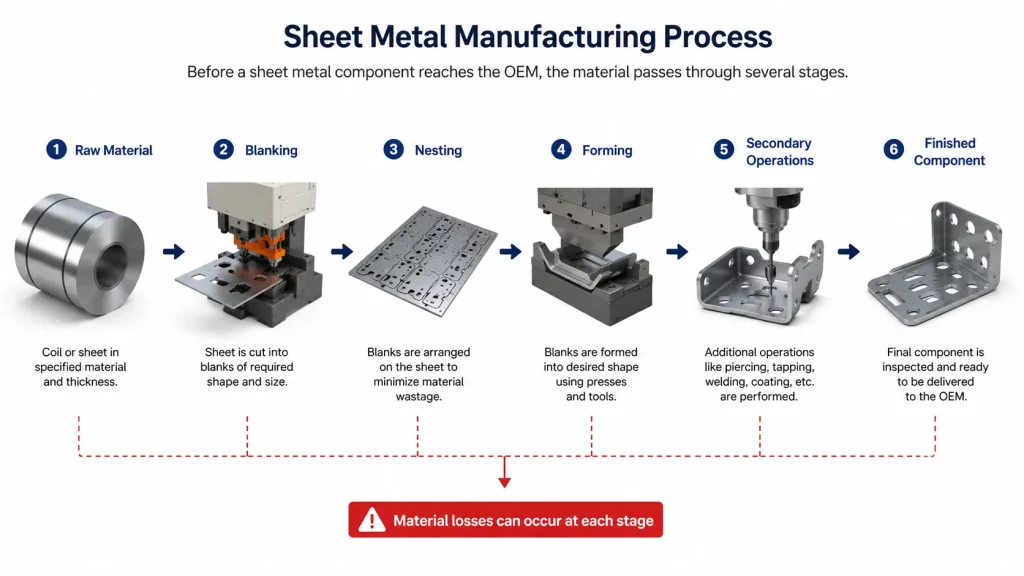
Before a sheet metal component reaches the OEM, the material passes through several stages:
Raw Material
↓
Blanking
↓
Nesting
↓
Forming
↓
Secondary Operations
↓
Finished Component
At each stage, material losses can occur.
A component weighing 0.8 kg may require significantly more than 0.8 kg of purchased material to manufacture.
Why?
Because not every portion of the sheet becomes a finished part.
Material is lost through:
Scrap Generation
Scrap is generated when portions of the sheet cannot be used for production.
Complex part geometries often create larger scrap zones.
Nesting Inefficiencies
Nesting determines how components are arranged on the sheet before cutting.
Poor nesting layouts leave large unused spaces between parts.
Coil Width Limitations
The selected coil width may not perfectly match the component dimensions, leading to unnecessary waste.
Edge Trimming
Many manufacturing processes require edge trimming, which further reduces usable material.
By the time production is complete, a significant percentage of purchased material may never become part of the final product.
This is where material utilization starts to have a greater impact than material price.
Why Two Suppliers Quote Different Prices for the Same Component
This is one of the most common questions asked by procurement teams:
“Why do two suppliers quote different prices for the exact same component?”
The drawing is identical.
The annual volume is identical.
The material specification is identical.
Yet one supplier is 8% to 15% more expensive.
Most buyers assume the difference comes from supplier margins.
In reality, the answer is often much more technical.
Different suppliers operate with different assumptions regarding:
- Material utilization
- Scrap percentage
- Nesting strategy
- Tooling design
- Production efficiency
- Press utilization
- Process capability
One supplier may achieve 88% utilization.
Another may achieve 72%.
That difference alone can dramatically change the material cost per component.
The supplier isn’t simply costing the steel.
The supplier is costing how the steel will be converted into parts.
And that’s where pricing differences begin to emerge.
The Procurement Mistake Most OEMs Make
Many procurement teams negotiate material price aggressively but rarely challenge material utilization assumptions.
As a result, they focus on the visible part of the cost equation while ignoring one of the largest hidden cost drivers.
Typical procurement questions include:
- What’s your steel price?
- Can you reduce your material rate?
- Can you provide a better commodity index?
These questions are important.
But they are incomplete.
The more powerful questions are:
- What material utilization percentage have you assumed?
- What scrap percentage is included in the quote?
- What nesting strategy are you using?
- Can the blank size be optimized?
- Is there a better coil width available?
- Can material yield be improved through design changes?
These questions shift the discussion from price negotiation to cost optimization.
And that’s where meaningful savings are usually found.
A Real Costing Scenario: When Expensive Steel Becomes Cheaper
Let’s look at a simplified example.
Suppose an OEM is sourcing a sheet metal bracket.
The finished part weighs 1 kg.
Supplier A purchases steel at ₹80 per kg.
Supplier B purchases steel at ₹85 per kg.
At first glance, Supplier A appears cheaper.
Most buyers would immediately prefer Supplier A.
But let’s examine the utilization rates.
Supplier A
Material Price = ₹80/kg
Material Utilization = 70%
Material Required to Produce 1 kg Part = 1.43 kg
Effective Material Cost = ₹114.40
Supplier B
Material Price = ₹85/kg
Material Utilization = 90%
Material Required to Produce 1 kg Part = 1.11 kg
Effective Material Cost = ₹94.35
Despite paying more for steel, Supplier B delivers a lower material cost per component.
This example highlights a critical lesson:
Material price alone never tells the complete cost story.
Material utilization determines how effectively that price translates into finished products.
And in many cases, utilization has a bigger impact on total cost than the material rate itself.
Why Material Utilization Is the Foundation of Should Costing
This is precisely why modern should-costing methodologies go beyond material prices.
A reliable should-cost model evaluates:
- Material utilization
- Scrap generation
- Blank dimensions
- Nesting efficiency
- Process route
- Tooling requirements
- Secondary operations
- Quality requirements
Without utilization analysis, should costing becomes little more than a material price calculation.
And that can lead to inaccurate cost targets and poor supplier negotiations.
This is where platforms like Cost It Right help manufacturers gain visibility into the true drivers behind component costs.
Rather than evaluating only supplier pricing, organizations can understand how manufacturing decisions influence the final quote.
The result is more accurate cost models, stronger negotiations, and better sourcing decisions.
How OEMs Can Improve Material Utilization
Improving utilization does not always require major investments.
In many cases, significant savings can be achieved through smarter engineering and sourcing decisions.
Optimize Part Geometry
Simple design changes can improve nesting efficiency and reduce scrap.
Review Blank Dimensions Early
Blank optimization should begin during product development, not after supplier quotations are received.
Evaluate Alternative Coil Widths
Selecting the right coil width can significantly improve yield.
Improve Nesting Strategies
Advanced nesting software can increase material utilization without changing the component design.
Encourage Collaboration Between Engineering and Procurement
Cost optimization is most effective when sourcing teams and engineering teams work together from the beginning.
Include Utilization in Supplier Reviews
Material utilization should be treated as a key performance indicator during sourcing and supplier evaluations.
Conclusion
For decades, procurement teams have been trained to focus on material prices.
And while material price remains an important cost driver, it is only one part of the equation.
The real question is not:
“How much does the material cost?”
The real question is:
“How much of that material actually becomes a finished part?”
That is where material utilization changes the conversation.
A supplier paying more for steel can still deliver a lower-cost component if they generate less scrap and use material more efficiently.
This is why leading manufacturers no longer evaluate supplier quotations based solely on material price.
They evaluate how effectively suppliers convert raw material into value.
Because in sheet metal manufacturing, the cheapest material does not always produce the cheapest component.
More often than not, the winner is the supplier who uses the material best.
FAQs
Material utilization is the percentage of purchased material that becomes part of the finished component. Higher utilization means less waste and lower cost per part.
Material utilization directly impacts effective material cost, scrap generation, and overall manufacturing efficiency.
Nesting determines how efficiently components are arranged on a sheet or coil. Better nesting reduces waste and improves material yield.
Different suppliers use different assumptions regarding material utilization, scrap rates, tooling, and manufacturing efficiency.
OEMs can reduce costs by improving material utilization, optimizing designs, reducing scrap, and validating supplier assumptions through should costing.
Higher scrap results in lower utilization. Lower utilization increases the effective material cost of each component.
In many sheet metal applications, yes. A supplier with better utilization can often achieve a lower cost per component even when paying a higher material rate.