Table of Contents
The real problem is not “data.” It is document-driven operations
Where unstructured documents create the most damage
Why OCR alone does not solve manufacturing document chaos
The hidden cost is not document processing time. It is decision latency
What high-performing manufacturers do differently
Where Cost It Right fits in this picture
Conclusion
FAQs
Manufacturing supply chains do not fail only because of shortages, delays, or supplier issues. They fail because the information needed to run them is scattered across PDFs, emails, scanned invoices, RFQs, Excel sheets, and folders that no system truly owns. In many organizations, the actual work of procurement, costing, and supply chain coordination still begins with documents created for humans, not systems. Gartner defines intelligent document processing as a way to extract data from multiple document formats and layouts precisely because enterprise documents are received in forms designed for human comprehension rather than machine processing.
That gap matters more in manufacturing than in many other industries. Supply chain automation depends on structured, reliable inputs, and IBM notes that supply chain automation uses AI, machine learning, and digital process automation to reduce manual intervention and streamline operations. But when the source data lives inside unstructured documents, the automation stack becomes fragile, slow, and exception-heavy.
This is why manufacturing teams often feel like they are running two businesses at once: one digital, one manual. The digital side lives in ERP, procurement, and planning systems. The manual side lives in inboxes, spreadsheets, shared folders, and supplier attachments. The cost of that split is not just administrative inconvenience. It is delayed sourcing, weak cost visibility, poor planning accuracy, version confusion, and avoidable operational risk.
The real problem is not “data.” It is document-driven operations
The phrase “unstructured data” can sound abstract, but in manufacturing it usually means something very concrete: a supplier sends a revised quote by email, the engineering team updates a BOM in a spreadsheet, finance receives an invoice as a scan, and procurement is expected to reconcile everything before production feels the impact. McKinsey describes this broader challenge as the gap between analog business operations and digital systems, noting that intelligent document processing helps bridge that gap, but still requires humans in the loop to configure, monitor, and handle exceptions.
That human dependency is not a failure of automation; it is a reminder of how messy the source material is. Documents in manufacturing are often semi-structured at best. Some have tables, some have free-text notes, some are image scans, some are email threads with attachments, and some change format every time a supplier sends them. Gartner’s definition of IDP reflects this reality by emphasizing ingestion from multiple formats, data extraction, preprocessing, review, and integration into downstream applications.
The practical consequence is simple: if your supply chain depends on people reading, comparing, and rekeying documents, then your workflows are already slower and more fragile than they appear on paper. The organization may have advanced systems, but the control layer is still manual.
Where unstructured documents create the most damage
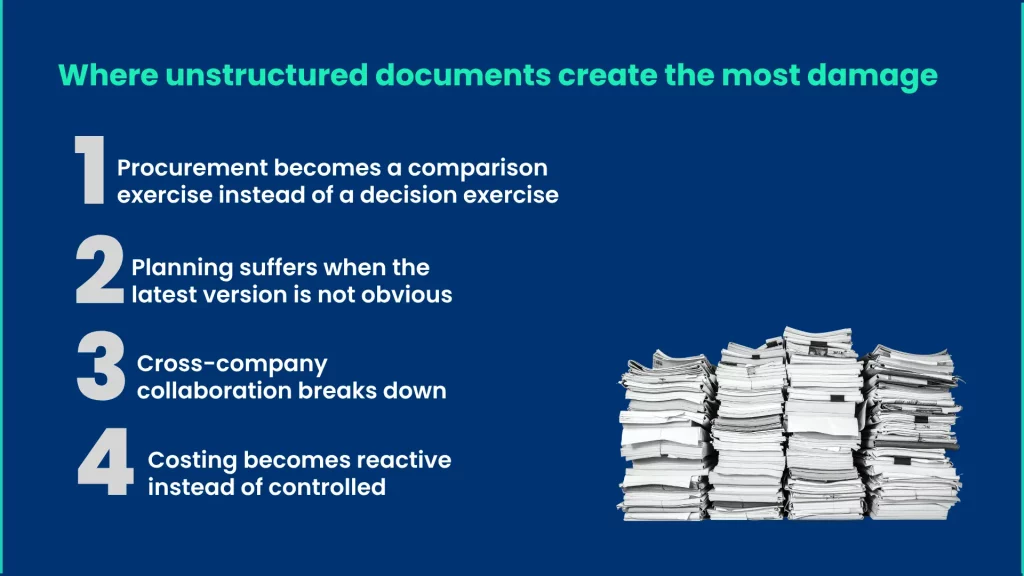
1) Procurement becomes a comparison exercise instead of a decision exercise
In an ideal process, procurement should evaluate suppliers on cost, capability, lead time, compliance, and business impact. In reality, teams often spend most of their time just trying to normalize data so the comparison can begin. Quotes arrive in different formats, line items use different labels, freight and tooling are buried in attachments, and commercial terms are hidden in email chains.
This is not a minor inconvenience. It is a decision-quality problem. When the inputs are inconsistent, the buying decision becomes slower and less reliable. That is exactly why document processing platforms exist: to classify documents, extract information, validate data, and turn document content into usable operational input.
2) Planning suffers when the latest version is not obvious
Manufacturing depends on version discipline. A small change in a quote, BOM, drawing, or supplier note can alter cost, material availability, and production timing. When multiple versions live in email threads and shared folders, people may act on the wrong one.
This is especially dangerous because planning systems assume that inputs are current and accurate. A study on production planning and control found that inaccurate data entries are the most common data quality problem in state-of-the-art PPC environments, and it linked strong data quality to high-performance outcomes. In other words, planning quality is not only a systems issue; it is a data discipline issue.
3) Cross-company collaboration breaks down
Manufacturing is a cross-company business. Suppliers, logistics partners, quality teams, procurement, finance, and engineering all need the same facts at the same time. A classic study on product data quality in supply chains found that timely and accurate product data is a critical success factor for efficient cross-company collaboration, and that missing or false compliance data can create fines and reputational damage, while inaccurate logistics data can endanger key business relationships.
That finding still maps directly to modern supply chains. If supplier information is late, incomplete, or inconsistent, collaboration turns into clarification. And clarification costs time.
4) Costing becomes reactive instead of controlled
Costing teams do not just need prices. They need the context around prices: what changed, why it changed, which part is affected, whether the quote revision replaces the old one, and what the downstream impact will be. When this information sits inside disconnected PDFs, spreadsheets, and inboxes, cost tracking becomes a retrospective activity rather than a live control process.
That is why “document management” is too small a phrase for the real problem. The issue is not filing documents. The issue is preserving cost logic across a supply chain that constantly changes.
Also Read- How Unstructured Data is Sinking Supply Chain Efficiencies
Why OCR alone does not solve manufacturing document chaos
Many companies start with OCR because it seems like the obvious fix. OCR can read text from scanned documents and PDFs, but reading text is not the same as understanding business meaning. IBM explains that intelligent document processing goes beyond OCR by using AI-powered automation and machine learning to classify documents, extract information, validate data, and structure unstructured content.
That difference matters in manufacturing. OCR can tell you a number exists on a quote. It cannot reliably tell you whether that number is the part price, tooling charge, freight cost, or a minimum order quantity. It cannot understand whether a revised quote supersedes a previous one. It cannot determine whether a supplier attachment is a compliance certificate, a corrective action note, or a commercial revision.
So while OCR is useful as a capture layer, it is not enough as a control layer. Manufacturing teams need systems that do more than extract characters. They need systems that preserve intent, context, and workflow continuity.
The hidden cost is not document processing time. It is decision latency
Most companies underestimate the true cost of unstructured documents because they measure only visible labor. They count the hours spent on data entry or reconciliation, but not the cost of waiting to decide. They do not always measure the cost of delayed RFQ closure, missed negotiation windows, slower supplier selection, late inventory updates, or production planning based on stale information.
This is where unstructured document management becomes a financial issue. Every delay increases the chance of exception handling, manual escalation, and operational drift. IBM’s supply chain automation guidance emphasizes that automation can reduce bottlenecks and unnecessary inefficiencies, while freeing people to focus on higher-level work. But that only happens when the underlying data is trustworthy enough to automate confidently.
In manufacturing, a small delay in a quote comparison may not look serious in isolation. But across hundreds or thousands of sourcing decisions, it compounds into slower cycle times, weaker negotiation leverage, and lower margin control.
What high-performing manufacturers do differently
The best manufacturing teams do not treat unstructured documents as isolated files. They treat them as operational signals that must be captured, standardized, validated, and connected to the business process.
That usually means four things.
First, they centralize incoming supplier and procurement content so that information does not disappear into inboxes and local drives.
Second, they use intelligent document processing to classify and extract information across multiple formats, not just from clean templates. Gartner’s definition of IDP explicitly includes ingestion from multiple formats, extraction, review, preprocessing, and integration into third-party applications.
Third, they keep humans in the loop where exceptions matter. McKinsey’s view is important here: IDP is not a magic replacement for process ownership. It works best when people configure, monitor, and resolve exceptions while the system handles the repetitive base work.
Fourth, they connect document intelligence to the systems that actually drive business decisions: procurement, costing, planning, inventory, and finance. Once documents feed structured workflows, the business moves from reactive cleanup to controlled execution.
Where Cost it Right fits in this picture
For manufacturing companies, the goal is not document storage. The goal is cost and procurement control.
That is where Cost It Right can be positioned very strongly: as a manufacturing intelligence layer that helps teams bring supplier data, costing information, and procurement logic into one operational view. Instead of treating quotes, spreadsheets, and revisions as scattered files, the platform can be framed as the place where manufacturing teams gain a reliable, decision-ready view of cost and sourcing information.
This positioning is stronger than generic “document management” because it speaks directly to the business pain: not just handling documents, but controlling the financial and operational impact hidden inside them.
Conclusion
Manufacturing supply chains do not struggle because documents exist. They struggle because the most important business information is trapped inside documents that were never designed for systems to understand. The result is slower procurement, weaker planning, poor version control, lower collaboration quality, and more manual effort than modern operations should tolerate.
The path forward is not simply more storage, more OCR, or more folders. It is document intelligence linked to business control. Intelligent document processing can help classify, extract, validate, and integrate information across formats, but the real advantage comes when that data is connected to sourcing, costing, planning, and execution.
For manufacturers, the opportunity is clear: turn documents from a source of delay into a source of control. The companies that do this well will make faster decisions, reduce errors, and protect margin in a supply chain where speed and accuracy now matter at the same time.
FAQs
Unstructured documents are files such as PDFs, emails, scans, spreadsheets, RFQs, invoices, and attachments that do not follow a fixed database structure and are difficult for systems to process automatically.
They slow procurement, create version confusion, reduce visibility, and force teams to spend time manually extracting and validating information before decisions can be made.
OCR reads text, but it does not understand business meaning, document type, or workflow context. IDP adds classification, validation, and integration.
Decision latency. The cost is not only document handling time, but also delayed sourcing, planning mistakes, and slower response to operational change.