Table of Contents
Why Are OEMs Struggling to Control Sheet Metal Component Costs?
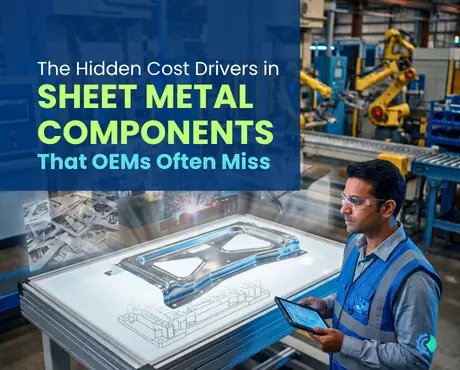
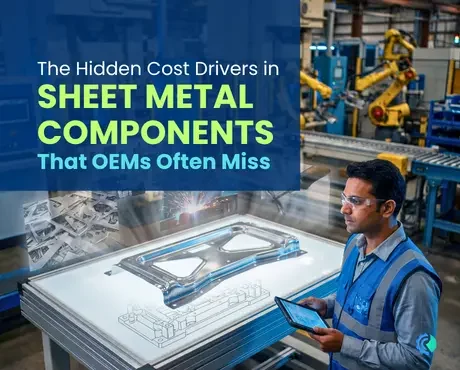
The Hidden Cost Drivers in Sheet Metal Components
Why Two Suppliers Quote Different Prices for the Same Part?
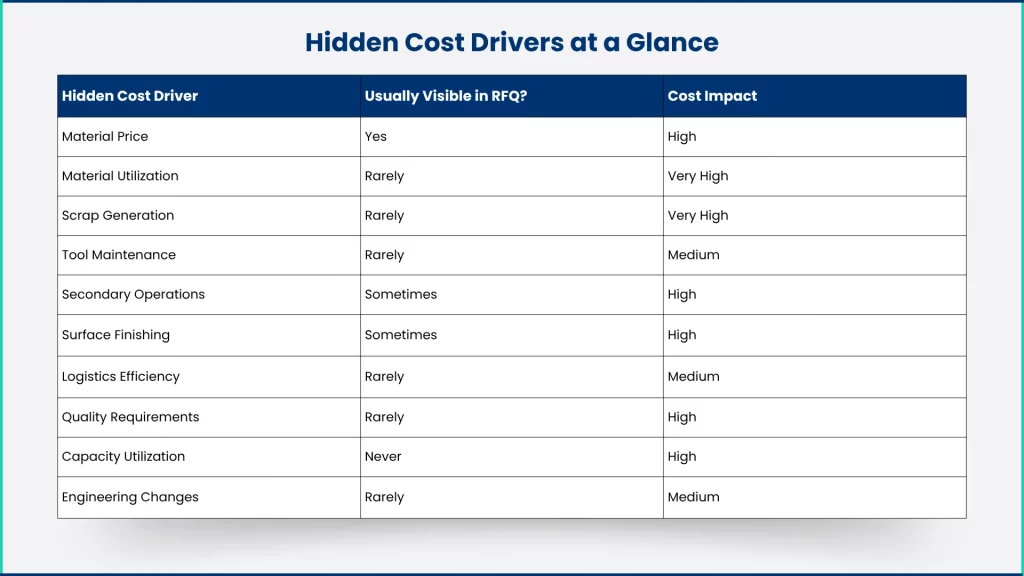
Hidden Cost Drivers in Sheet Metal Components at a Glance
How Hidden Costs Impact OEM Profitability
Why Traditional Costing Methods Miss These Hidden Costs
Conclusion
FAQs
Quick Answer
Most OEMs calculate sheet metal component costs using material prices, manufacturing costs, and supplier quotations. However, hidden factors such as material utilization, scrap generation, tooling complexity, secondary operations, tolerance requirements, and logistics costs can significantly increase the final component price. Understanding these hidden cost drivers helps manufacturers improve should-cost accuracy, negotiate better supplier quotes, and identify cost reduction opportunities.
Why Are OEMs Struggling to Control Sheet Metal Component Costs?
For many manufacturers, sheet metal components are among the most frequently sourced parts.
From brackets and enclosures to structural components and assemblies, sheet metal parts are used across industries such as automotive, industrial equipment, consumer goods, electronics, and heavy engineering.
Despite years of experience in procurement and sourcing, many OEMs still face a common challenge.
Why does the actual component cost often exceed expectations?
The answer lies in hidden cost drivers.
Most procurement teams focus on visible costs such as:
- Raw material prices
- Machine rates
- Supplier quotations
- Tooling investments
While these factors are important, they only tell part of the story.
A large portion of the final component cost is influenced by factors that rarely appear in RFQs, supplier quotations, or costing spreadsheets. These hidden costs often go unnoticed until the project enters production or supplier negotiations begin.
As manufacturers face increasing pressure to reduce costs and improve profitability, understanding these hidden cost drivers has become a critical part of effective procurement and should costing.
Let’s explore the factors that often have the biggest impact on sheet metal component pricing.
The Hidden Cost Drivers in Sheet Metal Components
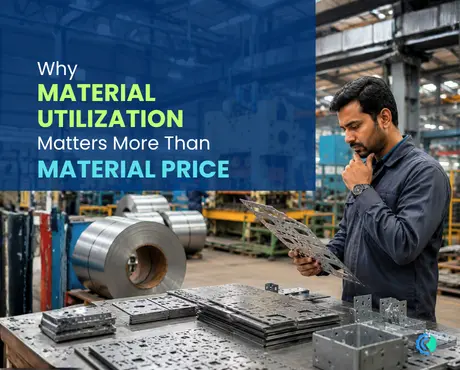
1. Material Utilization Can Have a Bigger Impact Than Material Price
When evaluating a sheet metal component, most buyers focus on the cost per kilogram of raw material.
However, suppliers focus on something different: material utilization.
A component weighing 1 kg does not necessarily require only 1 kg of steel to manufacture.
Depending on the blank design and nesting efficiency, a supplier may consume 1.3 kg, 1.4 kg, or even more material to produce that 1 kg component.
The remaining material becomes scrap.
Example
Component Weight: 1 kg
Steel Price: ₹80/kg
Procurement Assumption:
1 kg × ₹80 = ₹80
Actual Supplier Consumption:
1.4 kg × ₹80 = ₹112
The hidden cost is ₹32 per component.
Multiply this across thousands or millions of parts and the impact becomes substantial.
This is why material utilization is often one of the biggest cost drivers in sheet metal manufacturing.
2. Scrap Generation Directly Impacts Component Cost
Every sheet metal manufacturing process generates some level of scrap.
The real question is how much.
Factors affecting scrap generation include:
- Component geometry
- Blank layout
- Nesting efficiency
- Coil width selection
- Manufacturing process
A supplier generating 8% scrap and another generating 18% scrap will have very different manufacturing costs, even when producing the same component.
Unfortunately, scrap rates rarely appear in supplier quotations.
As a result, procurement teams often overlook one of the most important factors affecting component pricing.
3. Tooling Complexity Continues to Affect Costs Long After Tool Development
Many manufacturers focus heavily on the initial tooling investment.
However, tooling costs do not end when production begins.
Complex tooling requires:
- Regular maintenance
- Sharpening
- Spare components
- Sensor replacements
- Additional setup time
For example, a simple component requiring a 5-station progressive die will generally be less expensive to manufacture than a component requiring a 15-station die.
As tooling complexity increases, maintenance requirements increase as well.
Those costs eventually become part of the component price.
4. Tighter Tolerances Often Lead to Higher Manufacturing Costs
Engineering teams understandably want high-quality components.
However, tighter tolerances are not always necessary.
When extremely tight tolerances are specified, suppliers may require:
- More precise tooling
- Additional inspections
- Higher process controls
- Increased quality monitoring
These requirements increase manufacturing costs significantly.
In many cases, a tolerance can be relaxed slightly without affecting product performance while creating meaningful cost savings.
5. Secondary Operations Are Frequently Underestimated
Many sheet metal components require additional operations after the primary manufacturing process.
These operations may include:
- Welding
- Tapping
- Deburring
- Grinding
- Hardware insertion
- Assembly
While each operation may appear small individually, their combined impact can be substantial.
For some components, secondary operations contribute more to the final cost than the stamping process itself.
This is one reason why two seemingly identical parts can have very different manufacturing costs.
6. Surface Finishing Is Not a Fixed Cost
Many manufacturers treat surface finishing as a standard process.
In reality, finishing costs vary considerably depending on application requirements.
Common finishing processes include:
- Powder coating
- Zinc plating
- E-coating
- Galvanizing
- Painting
The final cost depends on:
- Surface area
- Coating thickness
- Corrosion resistance requirements
- Surface preparation requirements
A higher salt spray requirement or a specialized coating specification can significantly increase the cost of a component.
7. Logistics Costs Often Remain Hidden Until Production Starts
Two sheet metal components can have the same weight but completely different logistics costs.
The reason is packaging efficiency.
A compact component can often be stacked efficiently, reducing transportation and storage costs.
A bulky component may require:
- Larger packaging
- More warehouse space
- Additional transportation capacity
These costs are rarely included in early-stage cost analysis but can significantly impact the total cost of ownership.
8. Quality Requirements Add Costs That Are Not Always Visible
Modern OEMs have strict quality requirements.
These requirements often include:
- PPAP documentation
- First Article Inspection
- Statistical Process Control (SPC)
- Traceability systems
- Gauge calibration
- Process audits
While these activities improve quality and compliance, they also increase supplier operating costs.
Those costs are ultimately reflected in the component price.
9. Supplier Capacity Utilization Influences Pricing
Imagine two suppliers with similar capabilities.
One supplier is operating at 95% capacity.
The other is operating at 60% capacity.
Which supplier is more likely to offer an aggressive quote?
The supplier with available capacity.
Capacity utilization affects:
- Pricing flexibility
- Production scheduling
- Supplier margins
Yet it is rarely considered during supplier evaluations.
Understanding supplier capacity can provide valuable context during negotiations.
10. Engineering Changes Create Hidden Costs Throughout the Supply Chain
Engineering changes may seem minor on paper.
However, every design change can trigger:
- Tool modifications
- Additional validation
- Trial runs
- Documentation updates
- Process adjustments
The later these changes occur, the greater their impact on cost.
This is why manufacturers increasingly focus on cost optimization during the design stage rather than after production begins.
Why Two Suppliers Quote Different Prices for the Same Part?
This is one of the most common questions procurement teams ask.
The drawing is identical.
The material specification is identical.
The production volume is identical.
Yet supplier pricing can vary significantly.
Why?
Because suppliers are not simply costing the component.
They are costing the entire manufacturing process required to produce it.
Differences in:
- Material utilization
- Scrap generation
- Tooling strategy
- Machine utilization
- Quality requirements
- Capacity utilization
can create major pricing differences.
The drawing may be the same.
The manufacturing economics are not.
Hidden Cost Drivers in Sheet Metal Components at a Glance
Most OEMs focus on visible costs such as material prices and machine rates. However, many of the factors that have the biggest impact on component pricing are rarely visible in supplier quotations.
How Hidden Costs Impact OEM Profitability
When hidden cost drivers are ignored, manufacturers often face:
- Inaccurate should-cost models
- Weak supplier negotiations
- Unexpected cost increases
- Reduced profitability
- Missed cost reduction opportunities
The challenge is not that these costs are impossible to identify.
The challenge is that they are often buried inside supplier quotations and manufacturing processes.
Organizations that understand these factors gain a significant competitive advantage.
Why Traditional Costing Methods Miss These Hidden Costs
Many manufacturers still rely on spreadsheets, supplier quotations, and historical pricing data to evaluate component costs.
While these methods provide a basic understanding of pricing, they often fail to uncover the factors driving supplier quotations.
This is where modern cost intelligence platforms such as Cost It Right help procurement and cost engineering teams gain deeper visibility into:
- Material utilization
- Scrap generation
- Process costs
- Tooling costs
- Secondary operations
- Supplier cost breakdowns
Instead of negotiating based only on quoted prices, manufacturers can understand the actual cost drivers behind every component and make more informed sourcing decisions.
By bringing cost transparency into the sourcing process, organizations can build more accurate should-cost models and identify savings opportunities before negotiations even begin.to make decisions based on data rather than assumptions.
Conclusion
For many OEMs, sheet metal costing appears straightforward.
A material price is selected, manufacturing costs are estimated, and supplier quotations are compared.
However, the reality is far more complex.
Hidden cost drivers such as material utilization, scrap generation, tooling complexity, tolerance requirements, secondary operations, logistics efficiency, quality requirements, and supplier capacity utilization can significantly influence the final component price.
Manufacturers that understand these factors gain a clear advantage. They build more accurate should-cost models, identify cost reduction opportunities earlier, and negotiate with suppliers from a position of knowledge rather than assumptions.
As competition continues to increase and cost pressures grow across the manufacturing industry, visibility into these hidden cost drivers is no longer optional.
It is becoming essential for organizations that want to improve profitability, strengthen sourcing decisions, and maintain a competitive edge in the market.
Manufacturers that understand what truly drives component costs will always be in a stronger position than those who only focus on the final quoted price.
FAQs
The most common hidden cost drivers include material utilization, scrap generation, tooling complexity, secondary operations, tolerance requirements, surface finishing, logistics costs, quality requirements, and supplier capacity utilization.
Suppliers use different manufacturing processes, tooling strategies, machine capacities, material utilization rates, and cost structures, which affect their final pricing.
Material utilization refers to the percentage of raw material that becomes part of the finished component. Lower utilization leads to higher scrap generation and increased manufacturing costs.
OEMs can reduce costs by improving material utilization, simplifying component designs, optimizing tolerances, reducing secondary operations, and implementing should-costing practices.
Should costing helps manufacturers estimate what a component should cost based on materials, manufacturing processes, tooling, labor, overheads, and supplier margins.
Material utilization and scrap generation are often the largest hidden cost drivers because material typically represents a significant portion of the total component cost.
Procurement teams can analyze material utilization, scrap rates, tooling requirements, quality requirements, logistics costs, and secondary operations rather than focusing only on piece price.
Component cost refers to the final price paid for a part, while manufacturing cost includes all expenses associated with producing that part, including materials, labor, tooling, quality control, logistics, and overheads.
Yes. Understanding hidden cost drivers allows procurement teams to negotiate based on actual cost structures rather than relying solely on supplier quotations.
Cost It Right helps manufacturers gain visibility into material costs, manufacturing processes, tooling costs, and supplier quotations, enabling more accurate should-cost analysis and better sourcing decisions.