Table of Contents
The manufacturing sector is growing at a very fast pace. We are making everything from small parts to complex machinery. But, if you talk to any manufacturer, especially those dealing with custom orders, they will tell you the same pain point: costing and quotation is a headache. It is slow, often based on guesswork, and can lead to big losses if even one calculation goes wrong.
For decades, this process of quotation in manufacturing was a manual where even experienced engineers do everything on spreadsheets. But now, GenAI is making space in the manufacturing to produce fast, accurate, and reliable quotes. Let’s understand how Generative AI is impacting the costing and quotation process.
Why Traditional Methods of Quotation Does Not Work Anymore
Why is the old way of costing so difficult? Here’s why, imagine a customer asks you for a quote for a new component. What your team would do, they typically
- Get a 3D CAD file (like a blueprint).
- Then, an engineer will manually look at the design and list every single bolt, screw, sheet metal piece, and raw material. Paying attention to every single thing with focus makes the quotation process difficult and risky.
- After that, the engineer has to calculate the time required for every single process, CNC machining, welding, surface finishing, assembly. They look at past similar jobs, but past jobs are never exactly the same.
- For the final step, they need the latest price for raw materials (steel, copper, aluminum) and outsourced services (like specialized heat treatment). Things become unreliable at this place because the market prices change every day.
This whole process can take anywhere from three days to two weeks. By the time you send the quote, two things might have happened:
- Your competitor has already sent their quote and won the order.
- The price of your main raw material has changed, and your quote is now outdated or, worse, you’ve underquoted and will lose money.
The traditional system is too slow and depends too much on one or two experienced people. This is where GenAI steps in as the ultimate calculator and predictor.
How Generative AI Helps in Costing and Quotation
Generative AI is a type of Artificial Intelligence that can create new content, be it text, images, or, in our context, cost models and design ideas.
In manufacturing, GenAI does not just analyze your past data (that is traditional AI). GenAI’s power is in interpreting complex, unstructured data and generating solutions.
Think of it this way:
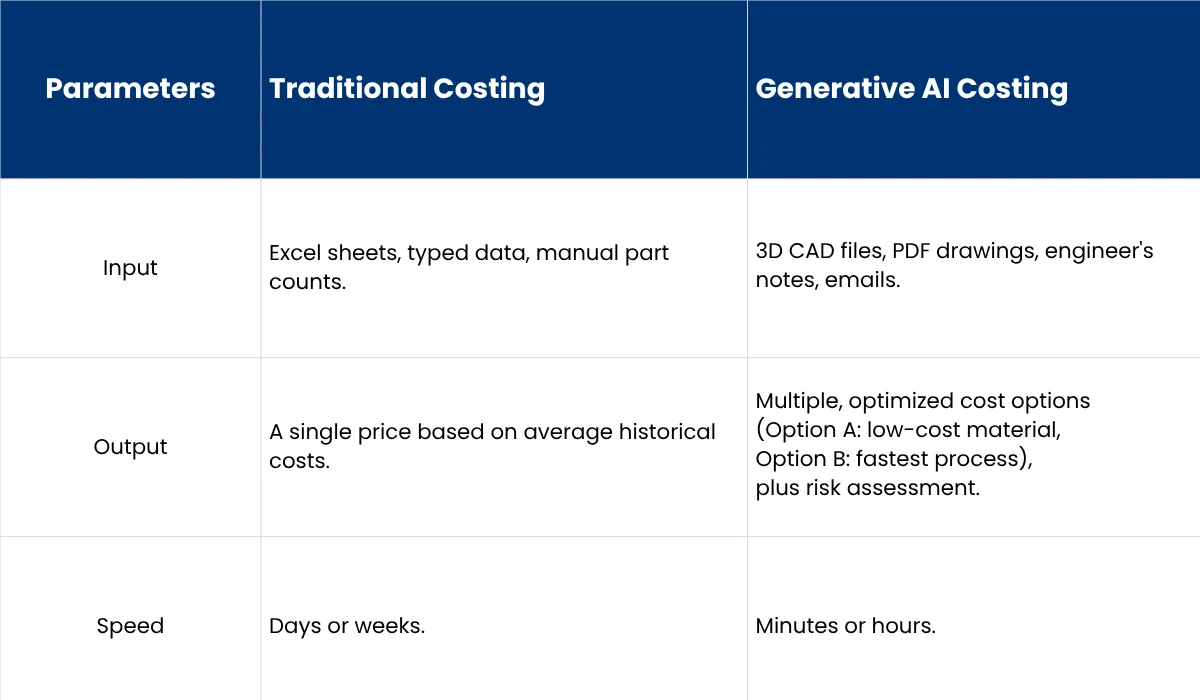
GenAI models are trained on thousands of engineering drawings, material data sheets, process times, and global supplier prices. When you give it a new 3D model, it understands the shape, material, and required process instantly.
What are the Benefits of Using Generative AI for Manufacturing Quotation
1.Automated Bill of Materials (BOM) Extraction (CAD-to-BOM)
This is the most time-consuming step manually. An engineer might take a full day to create a perfect BOM for a complex product with hundreds of parts.
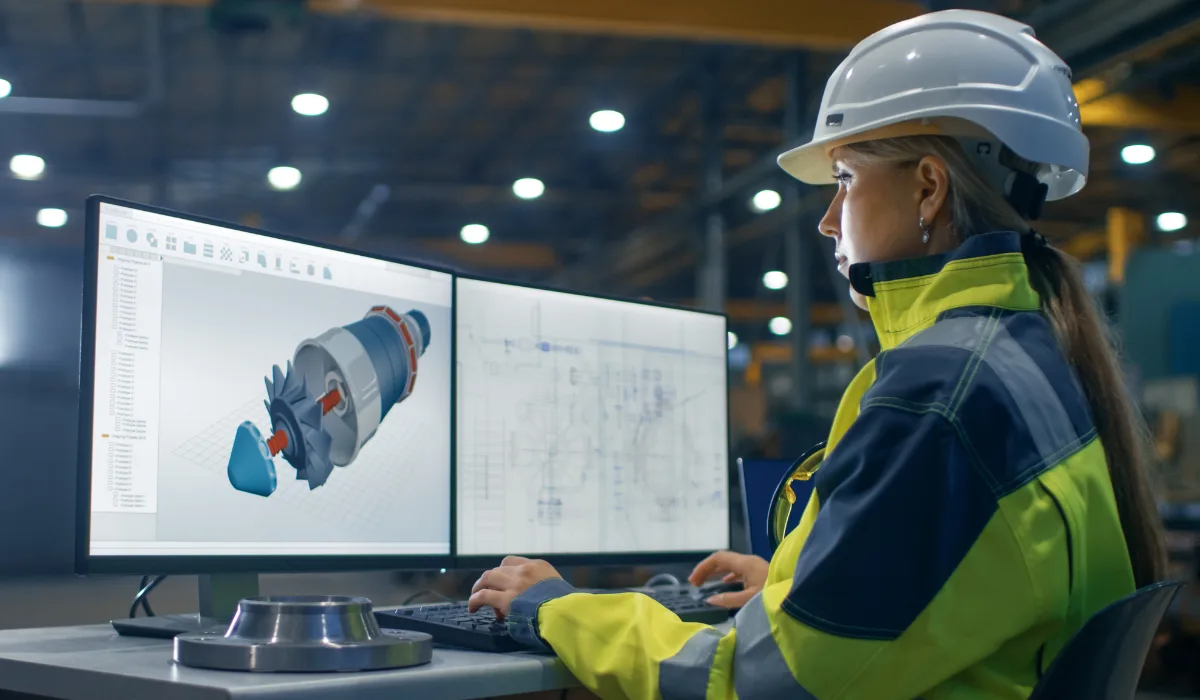
How GenAI helps: You upload the CAD file, and the GenAI model (often a multimodal AI) reads the 3D geometry and the part features. It can instantly count the number of components, recognize specific manufacturing features (like a hole, a fillet, a pocket), and list the required raw material dimensions.
The Result: The BOM is generated automatically in minutes, eliminating manual data entry errors and saving crucial engineering time. This means the time saved can be used for actual design optimization, not paperwork.
2. Real-Time Price Checks
Instead of calling five different vendors for the price of, say, stainless steel grade 304, the AI-powered quoting system connects to live market data feeds and your past purchasing records.
- How GenAI helps: It fetches the current market price, adjusts for delivery time and local Indian taxes (like GST), and plugs that value directly into your cost sheet. This ensures your quotation is accurate to the hour.
3. Automated RFQ (Request for Quotation) Generation
When you need an external service (like powder coating or laser cutting), GenAI can automatically generate the RFQ document.
- How GenAI helps: Based on the part’s geometry and surface area (which it read from the CAD file), it creates a standardized, accurate request, sends it to pre-approved suppliers, and even helps structure the comparison of the incoming supplier quotes.
The final result is a reliable quote delivered to the customer in hours, not days.
Also Read: How Quotation Management Software Helps You Win Faster
4. Predictive Costing for Material Volatility
The price of metals, oil, and energy (which impacts freight) is volatile. A sudden spike in steel price can kill your profit margin if you quoted based on last month’s rate.
- How GenAI helps: GenAI uses advanced Machine Learning models to analyze historical market trends, global economic news, and even geopolitical events. It generates a risk-adjusted price prediction. For example, it might tell you: “The current cost is ₹X, but there is a 70% chance of a 5% increase in the next 30 days. Recommend quoting at ₹X+3%.” This prediction helps you protect your profit.
5. Design-to-Cost Optimization
When a customer asks for a quote, the quote is usually final. GenAI allows you to explore multiple manufacturing options before finalizing the quote.
- How GenAI helps: It runs “what-if” simulations.
- Scenario 1: What if we change the material specification slightly (e.g., from aluminum grade 6061 to 6082)?
- Scenario 2: What if we use 3D printing for this part instead of CNC machining?
- Scenario 3: What if we combine three small parts into one single cast component (Generative Design)?
The AI-powered quoting systems generate a cost and timeline for all these variants. This allows your sales team to go back to the customer with three quoted options, Good, Better, Best, instead of just one. This is a massive competitive advantage.
6. Interpreting Unstructured Data
In Indian manufacturing, a lot of crucial information is often stored in PDFs, handwritten engineer notes, or buried in old email threads.
- How GenAI helps: Large Language Models (LLMs) can be fine-tuned to read, understand, and extract key information from these messy documents.
Example: An old technical drawing PDF from 2005 might contain a crucial note about a “special tolerance requirement.” GenAI extracts this note and automatically adds a cost buffer for the extra inspection time required. Without GenAI, this note might be missed, leading to a rejected batch and huge rework costs.
How AI-Powered Quotation Management Reduces Costs
AI quoting and price automation leads to several specific cost reduction benefits for manufacturers, such as:
- Labor cost savings: By automating repetitive tasks such as data entry, gathering product specs, and price calculations, AI can reduce quoting team workload by 40% to 70%, cutting down the need for additional staffing or overtime pay.
- Error reduction costs: Automated AI systems minimize human errors in quotes, reducing the frequency and cost of costly rework, order cancellations, and disputes, these error-related savings can amount to 20% or more of quoting-related expenses.
- Cycle time and opportunity cost savings: Faster quote generation powered by AI shortens the sales cycle, enabling companies to respond quickly to customer inquiries and capture more orders. This efficiency translates into increased revenue opportunities and reduced indirect costs linked to delays.
- Material and resource cost optimization: AI predicts raw material price fluctuations and optimizes supplier selection and inventory management, bringing down input procurement costs by 10%–15% in some cases.
- Operational overhead reductions: Reduced manual interventions and streamlined quoting workflows lead to savings in operational overhead such as IT support, document handling, and administrative expenses.
Overall, AI quoting and pricing automation can lower total quoting process costs by approximately 25% to 40%, delivering substantial savings while improving accuracy and speed.
Conclusion
For too long, the cost of a product was decided by tradition and gut feeling. Now, it is decided by data, speed, and accuracy. By adopting generative AI in manufacturing for costing and quotation, you are doing three key things:
- Increasing Hit Rate: You send faster, more professional quotes, so you win more orders.
- Protecting Profit: You catch hidden costs and predict price hikes, ensuring your margin is protected.
- Empowering Engineers: You move your skilled engineers away from manual data entry and toward high-value work like innovation and process improvement.
The time to think about this technology is over. The time to implement it, even in small stages, is now. Get your data right, start automating the BOM, and watch your costing process transform from a stressful bottleneck into your biggest competitive advantage.