

Table of Contents
Why China+1 Decisions Need Three Different Cost Numbers, Not One
What Actually Goes Into True Landed Cost
Why Should-Cost Modeling Matters More During a Supplier Transition
Comparing India, Vietnam, and Mexico: What Multi-Region Costing Needs to Account For
A Practical Framework for Costing a China+1 Decision Before You Commit
Why Most China+1 Guidance Stops at Strategy, Not Cost Modeling
How Cost It Right Supports Multi-Region, Multi-Currency Sourcing Decisions
FAQs
Why China+1 Decisions Need Three Different Cost Numbers, Not One
Most China+1 sourcing decisions are made by comparing one number across a handful of candidate suppliers: the quoted price. That’s the source of more bad sourcing decisions than any single other factor, because a quoted price is only one of three genuinely different cost figures a manufacturer needs before committing to a supplier shift.
Factory price is what a supplier quotes ex-works: the cost of the part leaving their factory gate, before freight, duty, or compliance are added. Landed cost is the true delivered cost once freight, duties and taxes, compliance and quality-control costs, and currency effects are layered on top of the factory price. Should-cost is different from both- it’s an independent, bottom-up model of what the part ought to cost based on material, labor, machine hour rate, and overhead, calculated without reference to any single supplier’s quote at all.
| Cost Figure | What It Captures | Risk If You Rely on It Alone |
|---|---|---|
| Factory Price | The quoted ex-works price for the part | Ignores freight, duty, and compliance entirely, and says nothing about whether the underlying cost structure is actually competitive |
| Landed Cost | Factory price plus freight, duty/taxes, compliance/QC, and currency effects | Gives you the true delivered cost, but still accepts the supplier’s quoted price as the starting baseline |
| Should-Cost | An independent, bottom-up model of material, labor, MHR, and overhead- built regardless of any supplier’s quote | Takes more upfront modeling effort, but is the only figure that tells you whether the price itself is fair, not just the logistics wrapped around it |
A China+1 decision built on factory price alone is incomplete. One built on landed cost is meaningfully better, but still inherits whatever assumptions the new supplier baked into their quote. Only landed cost and should-cost together- the true delivered cost, benchmarked against an independent view of what the part should actually cost- give a sourcing team a complete, defensible picture before they commit years of qualification effort and capital to a new supplier relationship.
This distinction matters more in 2026 than it did even a few years ago, because the volume of manufacturers making China+1 decisions simultaneously has grown sharply. When diversification was a niche strategy pursued by a handful of large multinationals, most of them had dedicated global sourcing teams building these models by hand. Today, China+1 has become a structural expectation across much of manufacturing, which means many teams making these decisions for the first time are doing so without a mature cost-modeling process already in place- and are far more likely to default to comparing factory prices alone simply because it’s the fastest number to get.
What Actually Goes Into True Landed Cost
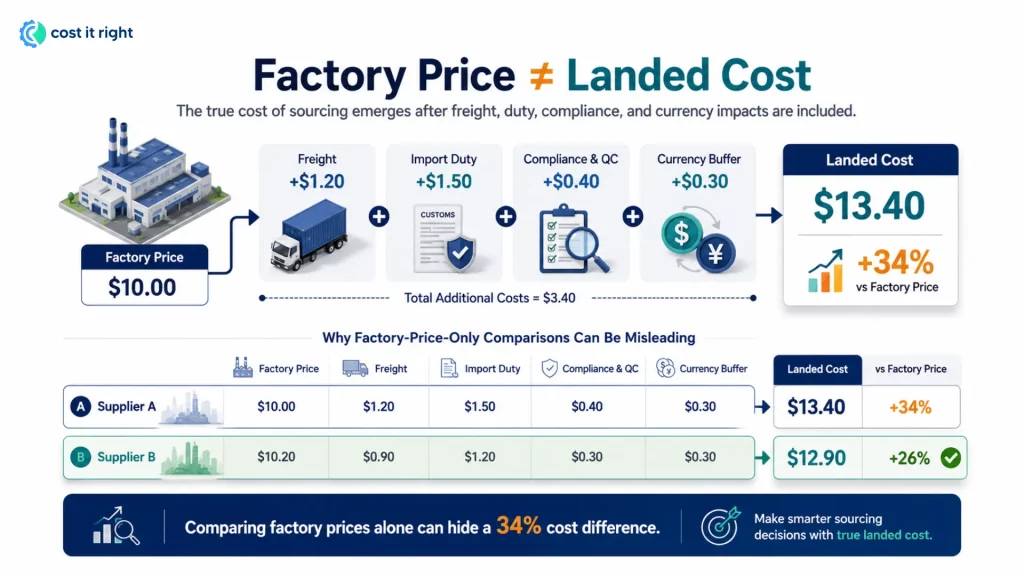
Landed cost is frequently underestimated because teams price a sourcing shift on the factory quote and treat everything after it as a rounding error. In practice, the gap between factory price and landed cost is often the difference between a sourcing decision that pays off and one that quietly erodes margin for years.
A complete landed cost calculation includes:
- Factory price: the supplier’s quoted ex-works cost
- Freight and logistics: ocean, air, or land transport from the new supplier’s location to your facility, including any transshipment legs
- Duties and taxes: import duty, any applicable tariffs, and local taxes at the destination
- Compliance and quality control: inspection, certification, and any rework or rejection costs tied to a new, unproven supplier
- Currency exposure: the cost or benefit of exchange rate movement between quoting and payment, which compounds over a multi-year supplier relationship
Why Should-Cost Modeling Matters More During a Supplier Transition
With an existing, long-standing supplier, a procurement team has years of price history, negotiation precedent, and performance data to lean on. A should-cost model is useful there, but it’s reinforced by everything else you already know about that relationship.
A China+1 sourcing decision removes all of that. The new supplier has no price history with you, no negotiation precedent, and however strong their reputation, no proven track record on your specific components. That makes an independent should-cost benchmark not a nice-to-have, but the only reliable reference point you actually have, since you can’t fall back on “this is close to what we paid last time” with a supplier you’ve never bought from.
This matters even more given how long supplier qualification actually takes. Industry guidance on China+1 transitions consistently points to a year or more to properly qualify a new factory, including capacity validation and quality system alignment- a long enough window that currency movements, commodity price shifts, and the supplier’s own cost structure can all change materially between the first quote and full production volume. A should-cost model gives a sourcing team a fixed, independent point of comparison to re-check the relationship against as it evolves, rather than only ever comparing the new supplier’s price to itself over time.
There’s a second reason should-cost modeling carries more weight during a transition: the new supplier is also, in effect, auditioning. Early quotes during qualification are frequently priced more aggressively than steady-state production pricing will be once volume ramps and the relationship matures — a well-documented pattern in supplier onboarding generally, not specific to China+1. Without an independent should-cost benchmark set before qualification begins, a sourcing team has no reliable way to tell whether a favorable early quote reflects genuine cost competitiveness or simply an introductory price that will drift upward once the switch has already been made and reversing course becomes expensive.
Also Read: What is AI-Powered Should-Cost Modeling and How it Helps Indian Manufacturers
Comparing India, Vietnam, and Mexico: What Multi-Region Costing Needs to Account For
India, Vietnam, and Mexico are consistently identified as the three leading China+1 alternatives, each suited to different priorities rather than being interchangeable options for the same sourcing problem.
| Destination | Often Best Suited For | Key Cost Consideration | Typical Trade-Off |
|---|---|---|---|
| India | Scale, component depth, and growing electronics manufacturing capability | Labor and machine rates vary significantly by state and industrial cluster | Strong supplier ecosystem depth for auto components and industrial goods; infrastructure and logistics costs vary more by region than in more centralized manufacturing hubs |
| Vietnam | Labor cost advantage and geographic proximity to Chinese component supply | Many Vietnam-based suppliers still depend on Chinese-sourced intermediates, creating a transshipment cost layer | Lower direct labor cost can be partly offset by continued reliance on Chinese inputs and logistics |
| Mexico | Nearshoring for North American demand, with USMCA tariff advantages | Landed cost benefits heavily from proximity to the US market rather than from lowest factory price | Strongest fit is specifically for North American-bound production, less advantageous for other export markets |
The practical implication for a costing team is that these three destinations don’t compete on a single “who’s cheapest” axis- they compete on different cost structures entirely, which is exactly why factory-price comparisons across them are especially misleading. A component that looks most competitive on Vietnam’s labor rate can lose that advantage once Chinese-sourced input costs and transshipment logistics are added back in. A Mexico-based quote that looks expensive on pure factory price can be the cheapest landed cost option for a US-bound product once tariff treatment is factored in.
This is also where multi-currency management stops being a back-office concern and becomes a core part of the sourcing decision itself. Comparing an India quote in INR, a Vietnam quote in USD, and a Mexico quote in MXN- each with a different currency volatility profile- on a single, standardized landed-cost basis is not something that holds up reliably in a spreadsheet built for one currency at a time.
A Practical Framework for Costing a China+1 Decision Before You Commit
- Build a should-cost model for the candidate component before soliciting quotes, so you have an independent benchmark to negotiate against rather than comparing new suppliers only to each other.
- Request a full landed-cost breakdown from every candidate supplier, not just a factory price- freight, duty, compliance, and currency assumptions should all be stated explicitly, not estimated after the fact.
- Benchmark every new quote against your should-cost model, not just against the incumbent’s price. A new supplier’s quote being cheaper than what you currently pay in China doesn’t confirm it’s actually a fair price for the part.
- Model currency exposure across the full qualification timeline, not just at the point of quoting- a year-plus qualification window is long enough for meaningful currency movement to change the economics of the decision.
- Revisit the should-cost model as the relationship matures, since early-stage quotes during qualification often carry different assumptions than steady-state production pricing.
Manufacturers running this process in disconnected spreadsheets typically lose the thread by step three or four- currencies get mixed up, landed cost assumptions live in someone’s inbox instead of the model, and the should-cost benchmark quietly falls out of date as the qualification process drags past its first year. That’s the specific operational gap a centralized costing platform is built to close: keeping should-cost, landed-cost, and multi-currency data connected to the same model throughout a process that can easily run twelve months or longer.
Why Most China+1 Guidance Stops at Strategy, Not Cost Modeling
Most published China+1 guidance- from logistics providers, trade consultancies, and site-selection advisors- is genuinely useful at the strategic level: which countries offer which incentives, how tariff exposure compares across destinations, what a Production-Linked Incentive scheme covers, how long a qualification process realistically takes. That content answers “should we diversify, and where.”
It rarely answers the second question a costing or procurement team actually has to solve: once you’ve picked a candidate country and a candidate supplier, how do you know if the number they’ve quoted you is actually a good one. Strategic guidance can tell you India offers strong component depth for auto parts, or that Vietnam’s labor rates are attractive- but it can’t tell you whether the specific quote sitting in your inbox for a specific bracket or housing reflects a fair cost structure or simply a supplier’s opening negotiating position.
That gap exists because answering it requires engineering-grounded cost data- material quantities, machine hour rates, labor time, tooling amortization- not macro market analysis. It’s a fundamentally different kind of work than the strategic sourcing content most China+1 guidance is built to provide, and it’s the specific layer should-cost and landed-cost modeling exist to fill.
How Cost It Right Supports Multi-Region, Multi-Currency Sourcing Decisions
Cost It Right’s multi-currency management and geographic cost-library accuracy were built specifically for this kind of decision- comparing suppliers across regions with genuinely different labor rates, machine costs, and currency profiles, rather than forcing every quote into a single-currency spreadsheet built around one home market.
Instead of rebuilding a should-cost model from scratch every time a new China+1 candidate enters the picture, Cost It Right keeps material, labor, and machine hour rate data calibrated to where a supplier actually operates, so a costing team can benchmark an India quote, a Vietnam quote, and a Mexico quote against the same should-cost logic- each expressed in its native currency, but comparable on a true landed-cost basis. Combined with RFQ comparison and approval workflows, that means a sourcing decision that would otherwise take months of manual spreadsheet reconciliation can be tracked, benchmarked, and revisited in one connected system throughout a qualification process that often runs a year or more.
For manufacturers specifically evaluating India as a China+1 destination, this matters in a way that’s hard to replicate with a platform calibrated primarily around a single home market: Cost It Right’s cost models are shaped by real, plant-level implementations with manufacturers already operating in India, not a global average extended outward after the fact requiring manual rework across disconnected spreadsheets.
FAQs
Factory price is the ex-works cost a supplier quotes before freight, duty, or compliance are added. Landed cost is the true delivered cost once freight, duties and taxes, compliance and quality-control costs, and currency effects are layered on top- often 20 to 35% above the factory price, depending on the component and destination.
Build an independent, bottom-up should-cost model for the component before soliciting quotes, based on material, labor, machine hour rate, and overhead data calibrated to the new supplier’s region. Benchmark every incoming quote against that model rather than only comparing new suppliers to each other or to your existing supplier’s price.
It depends heavily on the specific component, process, and destination market- India, Vietnam, and Mexico each offer different cost advantages rather than a uniform “cheaper than China” answer. A landed-cost and should-cost comparison specific to the component in question is necessary to answer this reliably, rather than relying on general labor-rate comparisons alone.
Properly qualifying a new factory- including capacity validation and quality system alignment- typically takes a year or more, which is long enough for currency movement, commodity prices, and supplier cost structures to change materially between initial quoting and steady-state production.
China+1 is a supply chain diversification strategy where a manufacturer retains a primary manufacturing base, often in China, while adding meaningful production capacity in at least one additional country to reduce the risk of relying on a single sourcing location.
Currency movement between the time a supplier quotes a price and when payment is made can meaningfully change the actual landed cost of a component, particularly over the extended timelines typical of supplier qualification and long-term contracts. Multi-currency cost modeling accounts for this directly rather than treating currency as a fixed assumption.
They answer different questions and are both necessary. Landed cost tells you the true delivered price of a specific supplier’s quote. Should-cost tells you whether that underlying price is actually fair. A sourcing decision based on only one of the two is incomplete.
Most China+1 guidance focuses on strategic questions- which countries offer which incentives, how tariff exposure compares, how long qualification takes- because that’s macro market analysis. Answering whether a specific supplier’s quote is actually fair requires engineering-grounded cost data such as material quantities, machine hour rates, and labor time, which is a fundamentally different discipline from strategic sourcing advice.