Table of Contents
What Is Raw Material Price Volatility?
What’s Actually Driving Raw Material Volatility in 2026?
How Does Volatility Actually Hit Manufacturing Margins?
What Are the Main Ways Manufacturers Manage This Risk?
What’s the Difference Between Hedging, Fixed Contracts, and Indexed Contracts?
How Does an Indexed Contract Clause Actually Work?
Worked Example: How Much Does Indexing Actually Change?
What Should Go Into an Indexed Contract Clause?
What Are the Trade-Offs and Risks of Indexing?
Why Doesn’t Generic Supply Chain Content Go Deep on This?
How Does Cost It Right Track Commodity Indices and Model Contract Impact?
FAQs
What Is Raw Material Price Volatility?
Raw material price volatility is the rate and unpredictability of price swings in materials a business depends on for production, driven by shifts in the balance between supply and demand. Low volatility means prices drift gradually and predictably. High volatility means prices move sharply, on short notice, in ways that are difficult to plan around.
Volatility isn’t inherently bad; it can create opportunity as well as risk, but sustained high volatility is what actually damages a manufacturer: it makes production costs, budgets, and supplier negotiations hard to plan around, and it hits hardest exactly where a business has the least flexibility, materials that are direct, unavoidable inputs to a product already under contract at a fixed price.
What’s Actually Driving Raw Material Volatility in 2026?
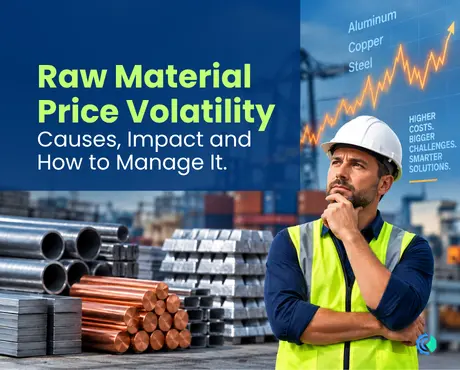
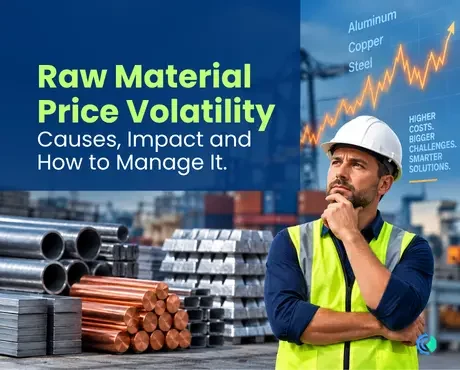
Three forces are driving unusually high volatility in industrial metals through 2026 specifically: tariff policy, regional supply shocks, and geopolitical conflict affecting production and shipping.
Aluminum is forecast by J.P. Morgan Commodities Research to average $3,800 per metric ton in Q3 2026 and $3,700 in Q4, driven partly by a possible 1.7 million metric ton global supply deficit and partly by the closure of two major Middle East smelters, Emirates Global Aluminum’s Al Taweelah and Aluminum Bahrain, together more than 6% of global aluminum supply, following regional conflict. Copper hit an all-time high above $14,500 per metric ton earlier in 2026, driven in part by disruption to sulfur and sulfuric acid supply used in copper leaching. Steel prices have become sharply region-dependent: tariffs are keeping US and EU prices elevated while a property-sector slump has pushed Chinese steel prices down over the same period, a divergence procurement teams sourcing across regions now have to account for directly rather than assuming one global steel price.
One concrete illustration of how disconnected regional pricing has become: industry analysis in 2026 has noted that US buyers are now paying roughly 70% more than the rest of the world for the same tonne of aluminum, a gap driven by tariff policy rather than underlying material cost. That’s not a temporary anomaly to wait out, it’s a structural feature of the current market that any contract or should-cost model built before 2026 tariff changes needs to be rechecked against.
How Does Volatility Actually Hit Manufacturing Margins?
Volatility hits margins hardest when a manufacturer is locked into a fixed-price customer contract while its own material costs move freely underneath it. The material cost embedded in a should-cost model or a signed quote reflects the index price on the day it was calculated, not the price six or twelve months later when the part is actually produced.
This is a timing mismatch, not a forecasting failure. Even a perfectly accurate should-cost estimate at the time of quoting becomes wrong the moment the underlying commodity index moves, and for materials with long contract cycles, tooling-heavy components in particular, that gap can persist for years. A manufacturer absorbing that gap alone eats the margin; a manufacturer trying to pass the full increase to a customer outside of any pre-agreed mechanism turns every price conversation into an adversarial renegotiation instead of a routine, expected adjustment.
What Are the Main Ways Manufacturers Manage This Risk?
Manufacturers generally draw on four levers to manage raw material price volatility, and most mature procurement functions use more than one at once rather than relying on a single approach.
Supplier diversification spreads purchasing across multiple suppliers and, where possible, multiple regions, so a price spike or supply shock tied to one source doesn’t fully pass through. Inventory buffering means holding additional stock of volatile materials to smooth out short-term price spikes, at the cost of higher carrying costs and warehouse space. Financial hedging uses instruments like forwards, options, and swaps to offset price risk directly in financial markets, effective but typically out of reach for manufacturers without in-house treasury expertise. Contractual mechanisms, fixed-price agreements, cost-plus arrangements, and indexed pricing clauses, address volatility directly in the commercial terms with suppliers and customers, rather than through inventory or financial markets.
Each lever addresses a different part of the problem, and none of them is sufficient alone. Diversification and inventory buffering reduce exposure to volatility; hedging and contractual mechanisms manage the financial impact once volatility happens anyway. The rest of this guide focuses specifically on the contractual mechanism most procurement content covers only in passing, indexed pricing clauses, because it’s the lever most directly tied to how a manufacturer’s own cost structure is built.
What’s the Difference Between Hedging, Fixed Contracts, and Indexed Contracts?
These three approaches to managing commodity price risk are often discussed together, but they work differently and protect against different things.
| Fixed-Price Contract | Financial Hedging | Indexed Contract | |
|---|---|---|---|
| What it does | Locks a price regardless of market movement | Uses financial instruments (forwards, options, swaps) to offset price risk | Ties the price to a published index, adjusting as the index moves |
| Who bears the risk | Whoever is disadvantaged when the market moves against the locked price | The counterparty to the financial instrument, for a cost | Shared, both sides move with the actual market |
| Best suited to | Short-term, low-volatility categories | High-volume, financially sophisticated buyers with treasury capability | Long-term supply relationships where fairness and predictability both matter |
| Main risk | Supplier default or dispute if the market moves far enough against them | Requires ongoing management and can be costly to execute well | Requires clear index selection, formula, and governance to avoid disputes over the mechanism itself |
A fixed-price contract is simplest but fragile under sustained volatility, someone eventually loses enough to break the agreement. Financial hedging works well for large, sophisticated buyers but requires treasury expertise most manufacturing procurement teams don’t have in-house. Indexed contracts sit between the two: less rigid than a fixed price, less operationally demanding than a hedging program, and directly tied to the material cost structure a should-cost model already tracks.
How Does an Indexed Contract Clause Actually Work?
An indexed contract clause adjusts the material-cost portion of a price up or down based on movement in a named, published commodity index, rather than a supplier’s request or a fixed number agreed once and left unchanged.
The mechanism has four working parts: a base index value recorded at the time the contract is signed, a material weight or percentage specifying how much of the part’s cost is actually tied to that material, an adjustment formula that recalculates the material cost line when the index moves, and a review cadence specifying how often the price is actually recalculated; monthly and quarterly are both common. Critically, the formula should adjust only the material-cost component of the price, leaving labor, overhead, tooling amortization, and profit untouched, since those elements aren’t driven by the commodity index at all.
Worked Example: How Much Does Indexing Actually Change?
Take a die-cast aluminum bracket with 0.4 kg of aluminum content per part, quoted when the aluminum index stood at $2,600 per metric ton. At that price, the material line comes to $1.04 per part. The bracket’s full quoted price, material plus labor, overhead, and profit, is $4.00.
Now the aluminum index moves to $3,800 per metric ton, in line with 2026 forecasts. Recalculating just the material line: 0.4 kg at $3,800/mt comes to $1.52, an increase of $0.48 per part. That’s a 46% jump in the material line alone, but against the bracket’s full $4.00 price, it’s a 12% increase overall, because labor, overhead, and profit didn’t move and the clause never touched them.
That gap, a 46% swing in the underlying commodity translating to a 12% swing in the actual part price, is exactly why indexing only the material portion matters. A renegotiation based on “aluminum is up nearly 50%” without that distinction risks a supplier asking for far more than the material movement actually justifies, or a buyer resisting an adjustment that’s actually fair once the math is isolated to the material line alone.
What Should Go Into an Indexed Contract Clause?
- Name a specific, published index. LME (London Metal Exchange) cash or three-month settlement prices are common for aluminum and copper; hot-rolled coil benchmarks are common for steel. Vague references to “market price” invite disputes over which market and which date.
- State the base index value and base price explicitly. Both sides need a documented starting point to calculate any future adjustment against.
- Specify the material weight or percentage precisely. This is what ties the index to the actual part, not just the commodity in the abstract.
- Set a review cadence. Monthly suits highly volatile materials; quarterly is more common for moderate volatility and reduces administrative overhead on both sides.
- Consider a threshold or collar. A minimum movement required before an adjustment triggers (for example, a 3% index move) avoids re-pricing over noise-level fluctuations that aren’t worth the administrative effort.
- Decide whether a cap or floor applies. Some contracts cap how much the price can move in either direction per period, trading some fairness for predictability on both sides.
- Document what’s excluded. Freight, currency effects, and duties typically need their own treatment; bundling them into a single material index clause usually creates more disputes than it resolves.
What Are the Trade-Offs and Risks of Indexing?
Indexed contracts solve the fixed-price fragility problem, but they introduce their own set of trade-offs worth acknowledging directly.
They require ongoing administration. Someone has to track the index, recalculate affected parts on the agreed cadence, and process the resulting price changes. Without dedicated tooling, this is exactly the kind of task that gets skipped once volume grows past a handful of parts.
Index selection itself can become a dispute. If a named index stops being published, changes methodology, or diverges from a supplier’s actual purchase price for legitimate regional or grade-specific reasons, the clause can start producing numbers neither side fully trusts.
They don’t protect against every kind of volatility. An indexed clause tied to a materials price index says nothing about freight cost swings, currency movement, or a supplier’s labor cost inflation, those need their own mechanisms if they matter to the relationship.
They can be harder to negotiate upfront. A supplier accustomed to simply asking for a price increase when costs rise may resist the more structured, formula-based approach initially, even though it ultimately protects both sides more predictably than ad hoc renegotiation.
Why Doesn’t Generic Supply Chain Content Go Deep on This?
Most supply chain and procurement content treats indexed pricing as one bullet point among many broader risk-mitigation strategies, alongside supplier diversification, inventory optimization, and financial hedging. That’s reasonable as a survey of options, but it means none of it goes deep enough to actually build a clause: which index to name, how to isolate the material-cost portion, what review cadence makes sense, or how to handle a threshold before an adjustment triggers.
That gap exists because building an indexed clause properly requires connecting commodity market data to an actual part-level cost structure, material weight, should-cost breakdown, machine hour rate, which is manufacturing costing work, not general supply chain risk management. A generic guide can tell you indexed contracts exist as an option. It generally can’t tell you how much of a $4.00 part’s price should actually move when aluminum jumps 46%.
How Does Cost It Right Track Commodity Indices and Model Contract Impact?
Cost It Right’s Commodity Movement and Master Movement reports track net landed rate movement over time for a given raw material code, across plants and vendors, so the index data behind an indexed contract clause is connected directly to the parts it actually affects, not tracked separately in a spreadsheet disconnected from the costing system.
The Cost Impact with External Indexing simulation goes a step further: before a price amendment actually takes effect, it shows the impacted parts, old cost versus revised cost per piece, and the volume-adjusted impact per quarter and per year, at the finished-goods level. That’s the mechanism from Section 7’s worked example, run automatically across every part tied to a given material, instead of one bracket recalculated by hand. For a manufacturer managing indexed clauses across dozens or hundreds of components, that’s the difference between a contract mechanism that works in principle and one that’s actually maintained in practice.
FAQs
Raw material price volatility is the rate and unpredictability of price fluctuations in materials a business depends on for production, driven by shifts in the balance between supply and demand, geopolitical events, tariffs, and other market disruptions.
Volatility describes the magnitude and unpredictability of price swings, which can move in either direction. Inflation specifically describes a sustained upward trend in prices over time. A material can be highly volatile without being in a sustained inflationary trend, and can be inflating steadily with relatively low day-to-day volatility.
An indexed contract ties the material-cost portion of a price to a published commodity index, so price adjustments track actual market movement on a predictable, pre-agreed basis instead of depending on ad hoc renegotiation, which reduces both the risk of absorbing an unrecoverable cost increase and the risk of a damaging supplier dispute.
A complete clause should name a specific published index, state the base index value and base price, specify the material weight or percentage tied to that index, set a review cadence, and address whether a threshold, cap, or floor applies to how much the price can move.
Labor, overhead, tooling amortization, and profit aren’t driven by commodity index movement, so indexing the full price rather than just the material line overstates how much the price should actually change when the index moves, and typically triggers disputes over the size of an adjustment.
They require ongoing administration to track index movement and recalculate affected parts; they depend on the continued reliability of the named index; they don’t address other volatility sources like freight or currency; and they can be harder to negotiate initially than a straightforward price increase request.
Aluminum is forecast to average $3,700 to $3,800 per metric ton through the second half of 2026, driven partly by Middle East supply disruptions. Copper reached an all-time high above $14,500 per metric ton earlier in the year. Steel prices have diverged sharply by region, with tariffs keeping US and EU prices elevated while a property-sector slowdown has pushed Chinese steel prices lower over the same period.