
Table of Contents
Manufacturing margins are under pressure from every direction. Raw material prices swing without warning, energy costs keep climbing, and customers still expect competitive pricing. Add compliance requirements and global supply chain volatility, and even well-run plants find their cost structures stretched thin.
Traditionally, manufacturers have tried to keep costs in check by tightening production efficiency. Lean processes, waste reduction, better supplier negotiations, all useful, but often too late. By the time a product reaches the factory floor, most of its cost has already been decided.
That’s where Product Lifecycle Cost Management (PLCM) comes in. Instead of chasing costs after they appear, PLCM gives companies the tools and data to plan, track, and control expenses from the moment a product is conceived until it’s retired. It shifts cost control from reactive firefighting to a structured, lifecycle-wide discipline that allows teams to lock in savings early and sustain margins through every stage.
In this blog, we’ll break down what PLCM really means, why it matters strategically, and how manufacturers can use it to build cost resilience at every stage of a product’s life.
What is Product Lifecycle Cost Management (PLCM)?
At its core, Product Lifecycle Cost Management (PLCM) is a systematic approach to understanding, planning, and controlling a product’s total cost across its entire lifecycle, from concept to disposal. Unlike traditional cost tracking, which focuses mainly on production, PLCM looks at all cost drivers, including design, procurement, manufacturing, distribution, maintenance, and end-of-life activities.
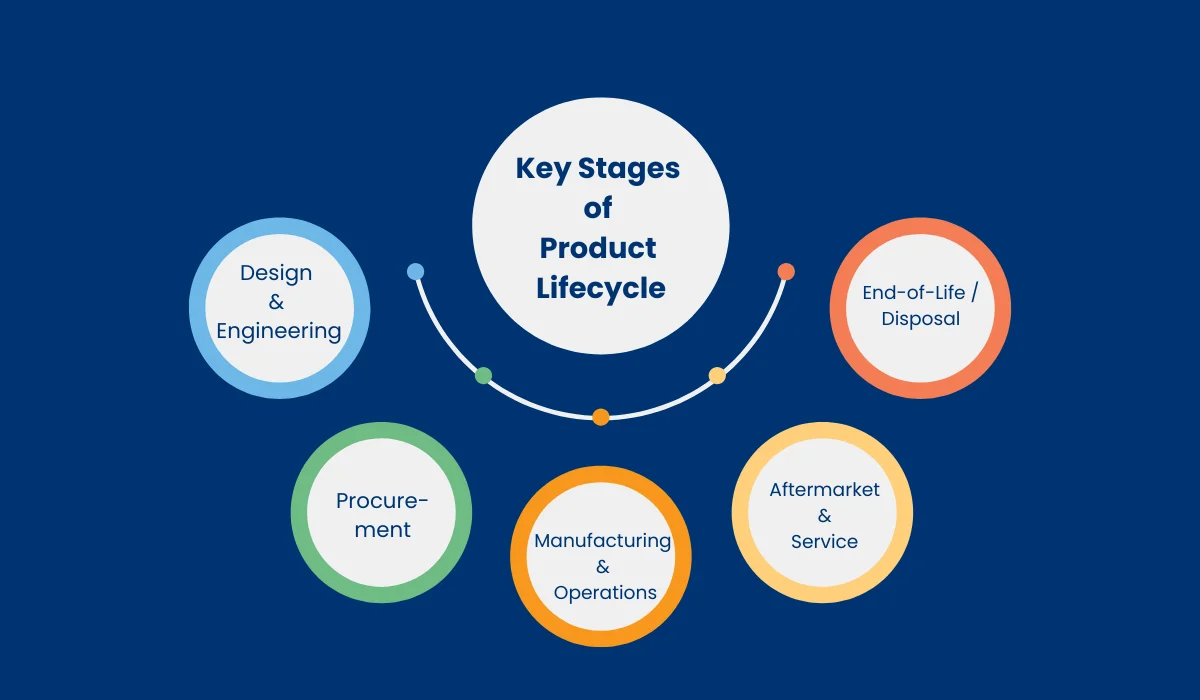
Think of a product’s life in phases:
- Design & Engineering: Material selection, complexity, and tooling decisions shape most of the future costs.
- Procurement: Supplier pricing, logistics, and sourcing strategies either lock in savings or create hidden expenses.
- Manufacturing & Operations: Efficiency, waste, and change orders directly affect margins.
- Aftermarket & Service: Warranty, maintenance, and spare parts influence lifetime profitability.
- End-of-Life: Disposal, recycling, or reuse decisions can add costs if not planned early.
By giving manufacturers visibility into all cost factors before they escalate, PLCM empowers data-driven decisions and prevents expensive surprises throughout the lifecycle.
What is the True Cost of Manufacturing a Product
Many manufacturers focus on direct production costs, materials, labor, and machinery, assuming these are the main expense drivers. In reality, up to 70–80% of costs are determined before the product reaches the shop floor, and several indirect costs accumulate quietly over time.
Costs typically fall into two categories:
- Direct Costs: Materials, labor, tooling, and production overhead, visible and easy to track.
- Indirect Costs: R&D, engineering changes, logistics, warranty claims, energy usage, compliance, and maintenance often overlooked but just as impactful.
Understanding both direct and indirect costs is essential for lifecycle cost optimization, preventing expensive surprises downstream. For example, a design decision that seems cheaper upfront, like using a lower-grade material, might increase rework or warranty costs later. Similarly, poor sourcing choices can lead to higher freight charges or unplanned overtime.
PLCM helps manufacturers see these costs holistically. By forecasting, tracking, and managing both visible and hidden costs from design through disposal, manufacturers gain the insight needed to make strategic, margin-preserving decisions rather than reacting to overruns downstream.
Also Read: 7 Best Practices for Product Lifecycle Cost Management
Key Stages Where PLCM Helps in Cost Control
Product lifecycle cost optimization isn’t just about tracking; it’s about identifying and acting on cost levers at each stage. Here’s how it plays out in practice.
a. Design & Engineering: Locking in Costs Early
Decisions made here determine the majority of future costs. PLCM encourages engineers to evaluate material, complexity, and tooling requirements before production begins. Techniques include:
- Should-cost analysis: Estimating ideal component costs before supplier quotes.
- Design-to-cost frameworks: Setting clear cost targets for parts and assemblies.
Early supplier involvement: Bringing procurement insights into the design phase.
For example, selecting a slightly more durable material might raise initial cost marginally but can cut warranty claims, service costs, and redesign work later. This early visibility locks in savings before expensive tooling or procurement decisions are made.
b. Procurement: Smarter Sourcing, Lower Risk
Procurement teams play a major role in cost control. A PLCM or procurement software helps them model total landed cost, factoring in logistics, tariffs, and supplier performance. With this visibility, teams can:
- Negotiate strategically, not just on unit price.
- Reduce exposure to supply chain disruptions through scenario analysis.
- Optimize the Bill of Materials (BOM) for total cost efficiency.
This shifts sourcing from transactional buying to cost-engineered procurement, where every decision supports lifecycle cost targets.
c. Production & Operations: Streamlining for Efficiency
Once production starts, PLCM provides real-time cost visibility, helping operations teams align execution with cost goals. This includes:
- Reducing waste and scrap through process optimization.
- Adjusting labor allocation based on live cost data.
- Minimizing change orders that originate from late-stage design tweaks.
Instead of finding overruns in post-production reports, manufacturers can course-correct in real time, avoiding cumulative cost leakage.
Also Read: How Manufacturers Can Analyze & Reduce Production Costs
d. Aftermarket & Service: Minimizing Post-Launch Surprises
Post-launch expenses often get less attention, but they can significantly impact lifecycle profitability. PLCM supports forecasting of warranty claims, spare parts demand, and service schedules to:
- Prevent unplanned service costs.
- Improve customer retention with reliable performance.
- Adjust pricing or service plans based on projected lifetime costs.
By planning ahead, manufacturers stabilize long-term margins rather than absorbing unpredictable service spikes.
e. End-of-Life: Planning for Disposal or Reuse
Disposal, recycling, or refurbishment decisions carry cost and regulatory implications. PLCM ensures:
- Compliance with environmental and legal requirements.
- Efficient reverse logistics.
- Opportunities to recover value through recycling or component reuse.
End-of-life planning prevents last-minute disposal costs and aligns with sustainability goals, which increasingly affect financial outcomes.
Top Benefits of PLCM for Manufacturers
Product Lifecycle Cost Management delivers tangible cost control benefits to manufacturers when embedded across functions:
- Early Cost Visibility: By modeling costs during design and sourcing, teams can prevent expensive late-stage changes, avoiding rework and production surprises.
- Cross-Functional Collaboration: Engineering, finance, procurement, and operations align on shared cost targets, breaking silos that often cause cost creep.
- Reduced Time-to-Market: Integrated cost control reduces design iterations and improves supplier coordination, accelerating launch without inflating costs.
- Higher Profit Margins: Systematic lifecycle cost control protects profitability even in volatile markets.
- Data-Driven Decisions: Teams evaluate trade-offs with real cost impact, not intuition or fragmented spreadsheets.
- Regulatory & ESG Compliance: Planning for sustainability and end-of-life reduces fines, avoids disruptions, and supports brand positioning.
With PLCM, manufacturers turn cost control into a strategic capability rather than an operational scramble, ensuring predictable margins and stronger financial resilience.
Conclusion
Cost control in manufacturing isn’t a single initiative, it’s a discipline that spans the entire product lifecycle. Product Lifecycle Cost Management brings structure to that discipline, turning fragmented cost tracking into a connected strategy.
By embedding cost visibility and control into every stage, from design to end-of-life, manufacturers move away from reacting to overruns and toward predictable, sustainable margins. In a market where volatility is the norm, PLCM isn’t just a finance tool, it’s a competitive advantage.
Frequently Asked Questions
Q1: What is product lifecycle cost management in manufacturing?
It’s the practice of planning, tracking, and controlling all costs a product incurs from design through end-of-life, including production, procurement, maintenance, and disposal.
Q2: How does PLCM help reduce product costs?
It identifies cost drivers early, supports data-driven design and sourcing decisions, reduces waste, and minimizes post-launch expenses like warranty claims or service costs.
Q3: At which stage can PLCM create maximum savings?
The design and engineering phase typically locks in 70–80% of total product costs, making early intervention the most impactful.
Q4: What tools are used for PLCM?
Manufacturers use ERP/PLM-integrated costing modules, digital lifecycle cost modeling tools, and scenario analysis software to track and forecast costs across stages.
Q5: How is PLCM different from traditional cost accounting?
Traditional accounting focuses on actual production costs. PLCM takes a forward-looking, cross-functional approach, covering the entire lifecycle and hidden costs to support strategic decisions.