Table of Contents
What Is Manufacturing Intelligence in Procurement?
Why Traditional Procurement Is Reaching Its Limits
Why Purchase Price Alone Is a Dangerous KPI
The Difference Between Procurement Data and Procurement Intelligence
The Six Layers of Manufacturing Intelligence Every Procurement Team Needs
How Manufacturing Intelligence Transforms Every Stage of Procurement
The Future of Procurement Will Be Built on Intelligence, Not Spreadsheets
Where Cost It Right Fits into Modern Procurement
Conclusion
FAQs
Procurement Is No Longer About Buying Parts. It’s About Making Better Business Decisions. For decades, procurement in manufacturing had one primary objective-purchase the right material, from the right supplier, at the lowest possible price.
Success was often measured by annual cost savings, negotiated discounts, or purchase price variance. If procurement teams could reduce the quoted price by a few percentage points, the sourcing exercise was considered successful.
That approach worked when supply chains were relatively stable, products were less complex, and raw material prices remained predictable for long periods.
Today’s manufacturing environment looks very different.
Raw material prices can change within weeks. Suppliers face capacity constraints, geopolitical disruptions affect global sourcing, product designs evolve more frequently, and customers expect faster deliveries without accepting higher prices.
At the same time, procurement leaders are expected to contribute far beyond purchasing.
They are responsible for reducing manufacturing costs, managing supplier risks, supporting engineering during product development, improving supplier performance, accelerating RFQ cycles, and protecting profitability even when market conditions become uncertain.
These responsibilities cannot be fulfilled by looking only at supplier quotations or historical purchase prices.
Modern procurement requires something much more valuable.
It requires Manufacturing Intelligence.
Not intelligence in the form of more dashboards or larger reports.
But intelligence that connects engineering decisions, supplier capabilities, manufacturing processes, commodity trends, cost models, and commercial data into a single decision-making framework.
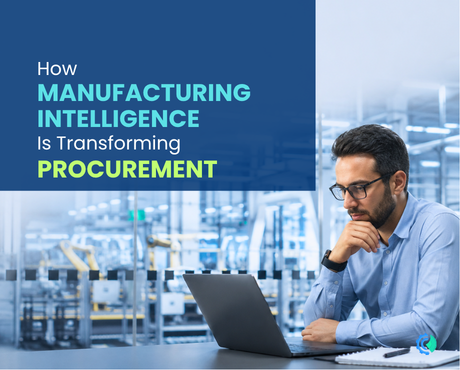
This is where Manufacturing Intelligence in Procurement is changing the way leading manufacturers source products, negotiate with suppliers, and control costs.
What Is Manufacturing Intelligence in Procurement?
Manufacturing Intelligence in Procurement is the practice of combining procurement data with engineering, costing, supplier, production, and market intelligence to make more informed sourcing decisions.
Unlike traditional procurement, which often focuses on obtaining the lowest quoted price, Manufacturing Intelligence evaluates every factor that contributes to the total manufacturing cost of a component.
Instead of asking,
“Which supplier quoted the lowest price?”
Procurement teams begin asking questions such as:
- Which supplier is using the most efficient manufacturing process?
- Does the quoted material utilization reflect industry benchmarks?
- Are tooling costs reasonable?
- How will future steel price fluctuations affect this quotation?
- Can a small engineering modification reduce the component cost significantly?
- Is the supplier quoting based on current production volumes or future capacity assumptions?
- Which supplier offers the best long-term commercial value rather than the lowest purchase price?
These questions fundamentally change procurement from a transactional function into a strategic business capability.
The result is not only better purchasing decisions but also stronger profitability, improved supplier relationships, and lower overall manufacturing costs.
Why Traditional Procurement Is Reaching Its Limits
Many procurement processes still follow a familiar pattern.
Engineering releases a drawing.
Procurement creates an RFQ.
Suppliers submit quotations.
Commercial negotiations begin.
A supplier is selected.
A purchase order is issued.
On paper, the process appears efficient.
However, one important question often remains unanswered.
Was the best commercial decision actually made?
Selecting the lowest quotation does not always mean selecting the lowest manufacturing cost.
A supplier may quote a lower price because they have assumed higher production volumes, lower inspection requirements, or shorter tool life.
Another supplier may appear more expensive because they are using higher-quality material, investing in automated production, or including additional quality assurance processes that reduce future warranty costs.
Without visibility into how each quotation has been built, procurement teams are effectively negotiating blind.
This explains why many organizations continue to experience unexpected cost increases even after achieving annual procurement savings targets.
The problem is not negotiation.
The problem is incomplete information.
Manufacturing Intelligence addresses this challenge by providing procurement teams with the context behind every quotation rather than simply comparing final prices.
Why Purchase Price Alone Is a Dangerous KPI
One of the biggest misconceptions in procurement is the belief that reducing purchase price automatically reduces manufacturing cost.
In reality, purchase price represents only one part of the total cost equation.
Imagine two suppliers quoting an automotive sheet metal bracket.
Supplier A submits a quotation of ₹94 per component.
Supplier B submits a quotation of ₹98.
Based on purchase price alone, Supplier A appears to be the obvious choice.
However, a deeper analysis reveals something different.
Supplier B achieves significantly better material utilization, resulting in lower steel consumption.
Their production line is highly automated, reducing process variation and quality defects.
They require fewer secondary operations, deliver shorter lead times, and maintain a consistently higher on-time delivery rate.
Over the life of the project, the slightly higher purchase price actually results in a lower total manufacturing cost.
Traditional procurement metrics rarely capture these differences.
Manufacturing Intelligence does.
Instead of measuring procurement success solely through negotiated discounts, organizations begin evaluating procurement based on overall business value.
That is a much stronger indicator of long-term profitability.
The Difference Between Procurement Data and Procurement Intelligence
Manufacturers generate enormous amounts of procurement data every day.
Purchase orders.
Supplier quotations.
Contracts.
Lead times.
Delivery schedules.
Commodity prices.
Supplier scorecards.
Most organizations already have access to this information through ERP systems and procurement software.
Yet many procurement teams still struggle to answer relatively simple questions.
Which supplier consistently delivers the best commercial value?
Which commodity price movements will affect next quarter’s profitability?
Which engineering decisions are increasing procurement costs?
Where are the biggest cost reduction opportunities across the supplier base?
The reason is simple.
Data answers what happened.
Intelligence explains what should happen next.
For example, an ERP system may report that steel prices have increased by six percent.
Manufacturing Intelligence goes further.
It identifies every affected component, estimates the financial impact on ongoing RFQs, highlights suppliers with lower exposure to commodity fluctuations, and recommends sourcing alternatives before costs escalate.
This is the difference between reporting and decision support.
And it is becoming one of the defining characteristics of world-class procurement organizations.
The Six Layers of Manufacturing Intelligence Every Procurement Team Needs
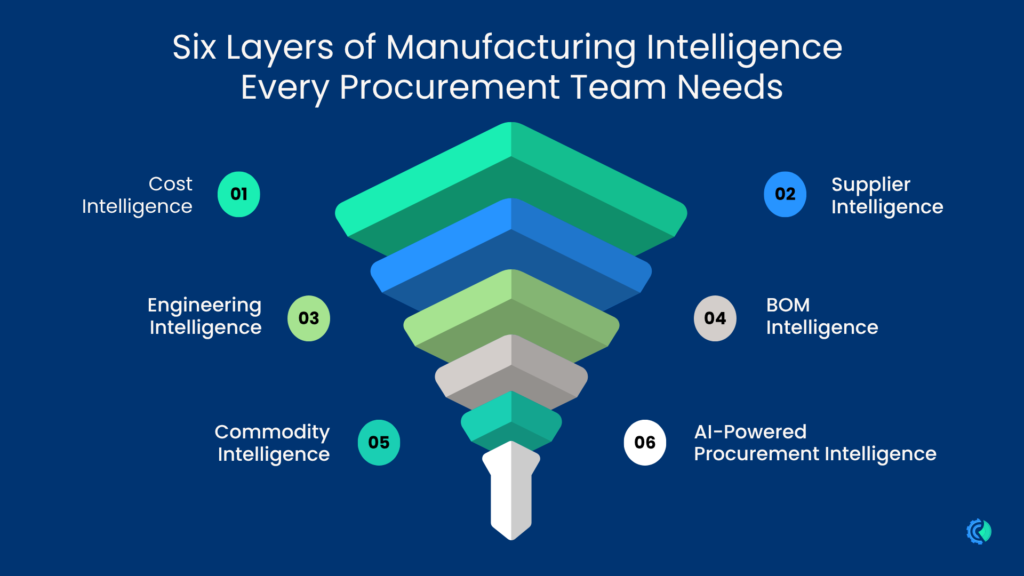
Leading manufacturers no longer rely on a single source of information when making procurement decisions.
Instead, they bring together multiple layers of intelligence to understand the complete commercial picture before awarding business to suppliers.
1. Cost Intelligence
Understanding exactly how a component should be manufactured, what each manufacturing process costs, and where suppliers may be adding unnecessary cost.
Cost Intelligence enables procurement teams to negotiate based on facts instead of assumptions.
2. Supplier Intelligence
Evaluating suppliers beyond pricing.
This includes manufacturing capability, process maturity, quality performance, financial stability, delivery consistency, tooling expertise, and historical commercial performance.
A supplier with a slightly higher quotation but excellent operational performance often delivers greater long-term value than the cheapest bidder.
3. Engineering Intelligence
Engineering decisions directly influence procurement outcomes.
Material selection, tolerances, manufacturing processes, and design complexity all affect supplier quotations.
When procurement teams gain visibility into engineering changes early, they can identify cost optimization opportunities before RFQs are released.
4. BOM Intelligence
The Bill of Materials is much more than a list of components.
It represents the commercial structure of a product.
Understanding how BOM changes affect supplier selection, inventory, procurement strategy, and manufacturing cost allows organizations to make smarter sourcing decisions throughout the product lifecycle.
5. Commodity Intelligence
Commodity markets rarely remain stable.
Steel, aluminium, copper, polymers, and energy prices continuously influence supplier quotations.
Procurement teams that monitor commodity intelligence alongside should-cost models can anticipate cost increases and negotiate proactively instead of reacting after prices change.
6. AI-Powered Procurement Intelligence
Artificial Intelligence is rapidly becoming a practical tool for procurement.
Rather than replacing procurement professionals, AI enables them to analyze supplier quotations faster, identify unusual pricing patterns, predict supplier risks, recommend negotiation opportunities, and automate repetitive sourcing activities.
However, AI delivers meaningful results only when it has access to connected manufacturing data.
This is why Manufacturing Intelligence forms the foundation for AI-driven procurement.
How Manufacturing Intelligence Transforms Every Stage of Procurement
The biggest advantage of Manufacturing Intelligence is that it doesn’t improve just one activity- it strengthens the entire procurement lifecycle. Instead of relying on assumptions at different stages, procurement teams gain access to connected data that supports better decisions from the moment an RFQ is created until supplier performance is reviewed.
Smarter RFQ Creation
An RFQ is often the first commercial interaction between an OEM and its suppliers. If the RFQ contains incomplete specifications, outdated BOMs, unrealistic production volumes, or missing process details, suppliers are forced to make assumptions. Those assumptions usually result in inconsistent quotations, making comparisons difficult.
Manufacturing Intelligence helps procurement teams create standardized, data-driven RFQs by combining engineering drawings, Bills of Materials, manufacturing requirements, commodity information, and historical sourcing data.
Instead of sending suppliers incomplete information, procurement teams provide complete manufacturing requirements, ensuring quotations are based on the same assumptions. This reduces quotation variations and makes supplier comparisons far more meaningful.
Better Supplier Selection
Choosing the right supplier has never been about selecting the cheapest quotation.
A supplier’s true value depends on several factors, including manufacturing capability, production capacity, tooling expertise, quality performance, delivery reliability, financial stability, and technical knowledge.
Manufacturing Intelligence allows procurement teams to evaluate suppliers using a complete commercial profile rather than a single purchase price.
For example, Supplier A may offer a lower quotation today, but Supplier B may consistently deliver higher quality, lower rejection rates, and better on-time delivery performance. Over the life of a project, Supplier B could generate significantly greater value despite having a slightly higher quoted price.
This shift from price-based sourcing to value-based sourcing is becoming a competitive advantage for leading manufacturers.
Quote Comparison That Goes Beyond Numbers
One of the most time-consuming procurement activities is comparing supplier quotations.
Most organizations still perform this exercise manually using spreadsheets.
The challenge is that every supplier prepares quotations differently. Material utilization assumptions vary. Manufacturing processes differ. Tooling costs are allocated differently. Overheads and profit margins are calculated using different methods.
As a result, comparing quotations line by line becomes extremely difficult.
Manufacturing Intelligence standardizes this process by breaking down supplier quotations into individual cost elements.
Instead of comparing only the final quoted price, procurement teams compare:
- Material costs
- Material utilization
- Scrap percentage
- Machine time
- Labour content
- Tooling cost
- Secondary operations
- Surface treatment
- Packaging
- Logistics
- Supplier margins
This level of transparency helps procurement teams identify why suppliers are quoting different prices and where negotiations should focus.
Negotiating with Data Instead of Assumptions
Traditional negotiations often revolve around a single request:
“Can you reduce your price by another 5%?”
Suppliers usually respond by protecting their margins or offering small concessions without addressing the actual cost drivers.
Manufacturing Intelligence changes the entire conversation.
Instead of negotiating blindly, procurement teams can discuss specific manufacturing assumptions.
For example:
“Our analysis indicates that material utilization can be improved from 74% to 81% using a different nesting strategy.”
Or,
“Why does your quotation include two secondary operations when the part geometry suggests one is sufficient?”
These conversations are far more productive because they focus on engineering and manufacturing realities rather than arbitrary discounts.
The result is stronger supplier relationships and more sustainable cost reductions.
Reverse Auctions Become More Effective
Reverse auctions are increasingly used by manufacturers to improve commercial competitiveness.
However, auctions only deliver value when suppliers compete on a level playing field.
If suppliers are quoting based on different manufacturing assumptions, the lowest bid may not represent the lowest manufacturing cost.
Manufacturing Intelligence ensures that reverse auctions begin with standardized technical assumptions, allowing procurement teams to compare suppliers fairly while maintaining quality and manufacturability.
Should-Cost Analysis Becomes Actionable
Many organizations understand the importance of should-cost analysis but struggle to implement it consistently.
Creating accurate cost models requires engineering knowledge, manufacturing expertise, commodity intelligence, and production data.
Manufacturing Intelligence connects all these elements into a single framework.
Procurement teams can estimate what a component should cost before supplier negotiations begin.
This creates confidence during sourcing discussions and enables buyers to challenge quotations using objective data rather than intuition.
Instead of negotiating for discounts, organizations negotiate toward realistic manufacturing costs.
The Future of Procurement Will Be Built on Intelligence, Not Spreadsheets
Manufacturing procurement is entering one of the biggest transformations in its history.
Over the next five to ten years, procurement leaders will be expected to make decisions that extend far beyond purchasing.
Several trends are already reshaping the function:
Artificial Intelligence will automate repetitive sourcing activities, summarize supplier quotations, detect pricing anomalies, and recommend negotiation strategies.
Predictive Procurement will use historical sourcing patterns, supplier performance, and commodity trends to identify risks before they affect production.
Real-Time Commodity Intelligence will continuously monitor steel, aluminium, copper, polymers, and energy markets, helping procurement teams understand how market movements affect individual components rather than simply tracking commodity indices.
Digital Supplier Collaboration will enable OEMs and suppliers to work together on cost optimization, manufacturability improvements, and engineering changes from the earliest stages of product development.
Sustainability Intelligence will become an important sourcing criterion. Procurement teams will increasingly evaluate suppliers based not only on cost and quality but also on carbon footprint, material traceability, energy consumption, and regulatory compliance.
Perhaps the biggest change will be the evolution of procurement itself.
Procurement professionals will spend less time creating spreadsheets and comparing quotations manually.
Instead, they will spend more time making strategic sourcing decisions supported by Manufacturing Intelligence.
The role will evolve from purchasing products to influencing profitability.
Where Cost It Right Fits into Modern Procurement
As procurement becomes increasingly data-driven, manufacturers need more than standalone procurement software.
They need a platform capable of connecting every commercial and technical decision.
This is where Cost It Right plays a different role.
Rather than functioning only as a costing application, Cost It Right serves as a Manufacturing Intelligence Platform designed specifically for manufacturing organizations.
It connects engineering drawings, Bills of Materials, supplier quotations, should-cost analysis, commodity intelligence, reverse auctions, procurement workflows, AI-assisted negotiations, customer RFQs, and supplier collaboration into a single connected environment.
Instead of switching between ERP systems, spreadsheets, emails, costing tools, and supplier portals, procurement teams work from one source of intelligence.
This enables manufacturers to:
- Create standardized RFQs faster.
- Compare supplier quotations transparently.
- Validate supplier pricing using should-cost analysis.
- Track commodity price movements.
- Identify hidden cost drivers before sourcing decisions are made.
- Conduct AI-assisted negotiations.
- Improve collaboration between procurement, engineering, costing, and finance teams.
- Make faster, data-driven sourcing decisions.
Ultimately, Cost It Right helps procurement move beyond operational purchasing and become a strategic contributor to business growth and profitability.
Conclusion
The expectations placed on procurement teams have changed dramatically. Success is no longer measured solely by negotiated savings or purchase price reductions. Today’s procurement leaders are expected to strengthen supply chains, manage risk, support engineering, improve supplier collaboration, and contribute directly to business profitability.
Achieving these goals requires more than experience and negotiation skills. It requires access to connected intelligence that explains not only what suppliers are quoting, but why they are quoting it and how those decisions affect the entire manufacturing business.
Manufacturing Intelligence provides that visibility. By bringing together engineering data, supplier insights, should-cost analysis, commodity intelligence, production knowledge, and procurement workflows, manufacturers can make sourcing decisions with greater confidence and accuracy.
As manufacturing becomes increasingly digital, organizations that continue relying on disconnected systems and manual spreadsheets will struggle to keep pace. Those that invest in Manufacturing Intelligence will build more resilient supply chains, negotiate from a position of knowledge, and create a sustainable competitive advantage.
For manufacturers looking to transform procurement from a cost center into a strategic driver of profitability, Manufacturing Intelligence is no longer an option- it is becoming a necessity. Platforms like Cost It Right are enabling that transformation by helping procurement teams make every sourcing decision with greater clarity, transparency, and intelligence.
FAQs
Manufacturing Intelligence in Procurement is the process of combining procurement, engineering, costing, supplier, production, and commodity data to support smarter sourcing decisions, reduce costs, and improve supplier performance.
Procurement Analytics primarily reports historical purchasing data, while Manufacturing Intelligence connects technical and commercial information to recommend better sourcing decisions before procurement activities take place.
It provides visibility into supplier cost structures, manufacturing assumptions, material utilization, tooling costs, and production processes, enabling procurement teams to negotiate using facts instead of assumptions.
AI helps procurement teams analyze quotations faster, predict supplier risks, automate repetitive tasks, identify pricing anomalies, and recommend negotiation opportunities. Its effectiveness increases when combined with Manufacturing Intelligence.
Should-cost analysis enables manufacturers to estimate the expected manufacturing cost of a component before supplier negotiations begin, improving pricing transparency and negotiation outcomes.
Yes. By identifying hidden cost drivers, improving supplier selection, validating quotations, and supporting data-driven negotiations, Manufacturing Intelligence helps reduce the total cost of procurement rather than focusing only on purchase price.
Automotive, aerospace, industrial equipment, heavy engineering, electronics, EV manufacturing, medical devices, consumer goods, and any organization managing complex supplier networks can benefit significantly.