


At its simplest, Explainable AI (XAI) refers to a set of tools and methodologies that make the results of machine learning models understandable to human users. Instead of simply providing an output (e.g., “This component will cost $55.30”), XAI systems explain the rationale and inner workings that led to that output (e.g., “The high complexity of the milling process accounts for 40% of this cost, and the specific aluminum alloy accounts for 35%”).
The need for transparency is amplified in high-stakes environments like manufacturing, where estimates directly affect cash flow and market competitiveness. Decision-makers need to understand why an AI model is recommending a specific price point before they commit resources or sign major contracts.
The fundamental difference lies in the contrast between black-box AI and explainable AI in manufacturing:
- Black-Box AI: These models, such as deep neural networks or complex ensemble methods, offer high predictive power but operate opaquely. They process data and deliver a result, but the chain of logic is too complex for a human to trace directly, making them untrustworthy for critical business functions like financial planning or risk management.
- Explainable AI: XAI either uses inherently transparent AI models (like linear regression or decision trees) or applies post-hoc techniques to opaque models to generate human-readable explanations. It doesn’t just predict the answer; it tells the story of the data that shaped the answer, making the AI predictions justifiable. For effective cost estimation in manufacturing, this justification is paramount.
Also Read: Why Integrate AI in ERP Systems for Cost Forecasting

1. Impact on Pricing, Budgeting, and Profitability
In manufacturing, accurate cost estimates directly feed into pricing models. If an AI estimates a part cost at $100, and a traditional analyst estimated $80, a pricing manager must know why. Is the discrepancy due to a newly factored supply chain risk, a recent surge in a specific raw material, or simply an overreliance on outdated labor rates? Without explainability, the pricing manager is flying blind, risking either losing a deal to a competitor or, worse, accepting a deal that erodes profitability. Opaque AI predictions turn confident financial planning into guesswork.
2. Risks of Relying on Opaque AI Predictions
Opaque models are vulnerable to subtle biases in the input data. If the historical data disproportionately features highly efficient suppliers or, conversely, consistently underestimates machine downtime, the resulting AI predictions will perpetuate and amplify those flaws. When a model simply states a cost without context, managers cannot identify:
- Data Quality Errors: Did the model overemphasize a data point that was recorded incorrectly (e.g., a massive outlier in historical labor hours)?
- Model Skew: Is the model penalizing a certain manufacturing process (like 3D printing) because early, inefficient attempts skewed the training data?
If you cannot inspect the model’s rationale, you cannot identify or correct these risks, making the entire organization vulnerable to flawed decision-making.
How Explainability Builds Confidence Among Stakeholders?
Trust is the ultimate currency of successful AI adoption. Explainable AI builds confidence across the organization:
- Engineering and Production: They can see which design choices (material thickness, feature complexity) disproportionately increase cost, enabling them to redesign for manufacturability and value.
- Procurement and Supply Chain: They gain leverage in supplier negotiations by understanding the exact cost drivers, material market prices vs. specific machine time, justifying their target prices.
- Leadership and Finance: They can confidently sign off on budgets and strategic pivots, knowing the cost estimation has been thoroughly vetted and defended by traceable logic, not just an algorithm’s output. This confidence is crucial for driving successful AI adoption in manufacturing.
Also Read: What is AI-Powered Should-Cost Modeling and How it Helps Indian Manufacturers
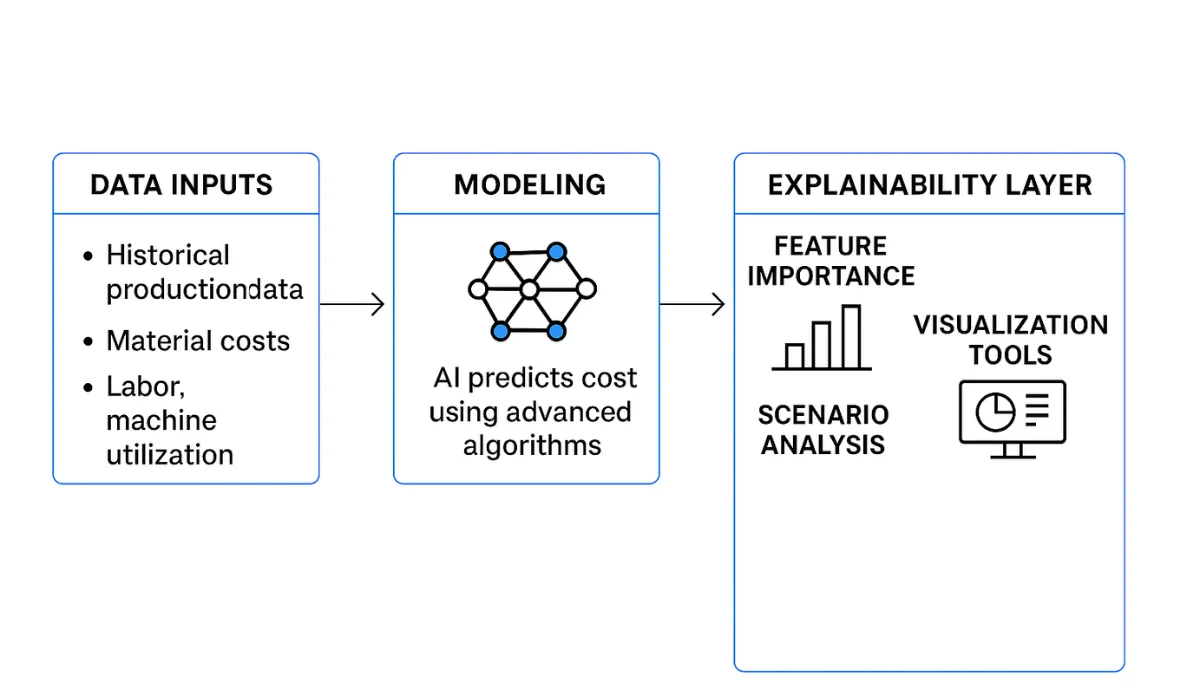
Implementing Explainable AI in cost estimation is a multi-layered process that transforms raw data into transparent, actionable insights.
Data Inputs
The foundation of any robust AI cost estimation system is comprehensive, high-quality data. In a manufacturing context, this typically includes:
- Historical Production Data: Actual costs, cycle times, yield rates, and scrap rates from past orders.
- Material Costs: Real-time and historical commodity prices, purchase order records, and negotiated supplier prices.
- Labor: Hourly wages, skill level requirements, and efficiency rates for specific machines or processes.
- Machine Utilization: Maintenance logs, setup times, and true operational cost per hour for various equipment.
2. Modeling and the Explainability Layer
The AI model (e.g., Gradient Boosting Machines or Random Forests) ingests this complex data to predict the cost. The Explainability Layer then works to reveal the model’s internal logic.
Feature Importance
This is the most fundamental component of XAI. Global Feature Importance shows which input variables, across all predictions, have the greatest influence on the predicted cost. For example, the model might consistently show that “Material Price” accounts for 60% of the cost variance and “Part Volume” for 25%. This guides business strategy, highlighting areas where optimization (like bulk buying) will have the greatest impact.
Visualization Tools: Dashboards and Charts
Explanations must be visually intuitive. XAI solutions typically offer dynamic dashboards that display explanations specific to a single quote. Users can instantly see a stacked bar chart showing the percentage contribution of each factor, material, machining time, setup costs, and risk premium to the final dollar amount. This simplifies complex AI predictions into easy-to-digest visual breakdowns.
Scenario Analysis and “What-If” Simulations
The true benefit of using transparent AI models in manufacturing cost estimation is the ability to conduct interactive sensitivity analysis. Procurement and engineering teams can run rapid “what-if” simulations:
- What if we switch from Aluminum 6061 to Stainless Steel 304? The XAI model instantly calculates the new cost and, crucially, explains why the cost changed, detailing the new material cost percentage and the impact on machining time due to the harder material.
- What if the order volume is doubled? The model can explain how the cost per unit decreases due to improved machine utilization and reduced setup time.
This function allows for proactive decision-making and optimization rather than just passive acceptance of an estimate.
3. Techniques Used: SHAP and LIME
For complex, black-box models, post-hoc interpretability techniques are essential:
- SHAP (SHapley Additive exPlanations): Based on cooperative game theory, SHAP values provide a unified measure of feature importance that calculates the contribution of each feature to the difference between the actual prediction and the average prediction. For a specific part, SHAP can clearly show that “Material Cost pushed the price up by $12.50,” while “High Part Volume pulled the price down by $4.00.” This is the gold standard for providing local (per-prediction) explanations.
- LIME (Local Interpretable Model-agnostic Explanations): LIME works by approximating the complex model’s prediction locally with a simpler, interpretable model (like a linear regression). This approximation is localized to the specific data point being predicted, offering insight into why the model made that one specific prediction.