Table of Contents
Manufacturing companies are not short of data anymore. They are surrounded by it. Costing sheets, procurement records, RFQs, vendor quotes, production inputs, material prices, amendments, and reports are created every day. But the real problem is that most of this data is scattered across Excel files, emails, different systems, and different teams. Because of this, many important decisions are still made without a clear view of the final cost, supplier impact, or product-level profitability. In 2026, this gap is becoming too expensive to ignore. This is where manufacturing intelligence becomes important.
What is Manufacturing Intelligence
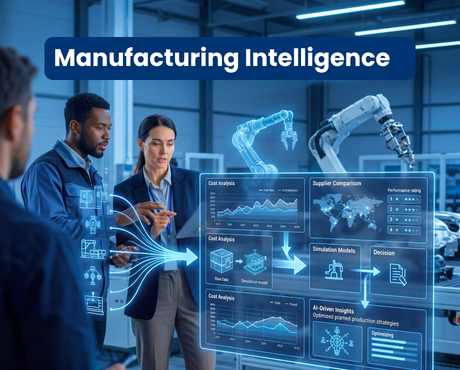
Manufacturing intelligence is the process of connecting and analyzing data from costing, procurement, production, RFQs, vendors, and operations to help manufacturing companies make better decisions. Instead of depending on scattered Excel sheets, emails, and delayed reports, manufacturing intelligence gives teams a clear view of cost, process, supplier, and product-level impact in one place. It helps manufacturers improve cost visibility, reduce cost leakage, compare vendor quotes, and make faster, more profitable decisions with confidence.
Why Manufacturing Intelligence Matters in 2026
1. Cost pressure is at an all-time high
Material prices, logistics, and supplier costs are constantly changing.
Decisions made without cost visibility lead to:
- margin erosion
- wrong supplier selection
- poor pricing
Speed without cost context is dangerous.
2. Supply chains are no longer stable
Lead times change. Suppliers fail. Demand shifts.
Static planning doesn’t work anymore.
You need intelligence that adapts in real time.
3. Decision cycles are shrinking
RFQs, sourcing decisions, and production changes happen faster than ever.
Teams don’t have time for:
- manual analysis
- disconnected tools
- delayed approvals
Decisions must be data-backed and instant.
4. Data is everywhere but clarity is not
Most manufacturers already have:
- ERP systems
- dashboards
- reports
But still struggle to answer:
Which decision is best right now?
Why Most Manufacturers Still Get It Wrong
They confuse dashboards with intelligence
Dashboards show data.
They don’t tell you what decision to take.
They lack cost visibility at decision time
Costing is often separate from operations.
So decisions are made without understanding:
- total cost
- trade-offs
- financial impact
They don’t simulate decisions
Most teams react after problems happen.
Instead of:
- predicting cost impact
- testing scenarios
- evaluating options
They rely on assumptions.
They rely on experience over systems
Decisions stay in people’s heads.
Not in:
- workflows
- systems
- repeatable processes
This doesn’t scale.
Data vs Manufacturing Intelligence
| Data / Analytics | Manufacturing Intelligence |
|---|---|
| Shows reports | Drives decisions |
| Historical view | Future-focused |
| Visibility | Action |
| Disconnected from cost | Cost-aware decisions |
| Passive | Decision-driven |
What Real Manufacturing Intelligence Looks Like
In 2026, real manufacturing intelligence has four layers:
1. Data
Operational, supplier, and market inputs
2. Cost Visibility
- should-cost
- landed cost
- supplier comparison
3. Simulation
- “What if” scenarios
- risk evaluation
- cost impact before action
4. Decision Workflow
- structured decisions
- faster approvals
- repeatable outcomes
This is where intelligence becomes real.
Conclusion
In 2026, manufacturing intelligence is not about having more data.
It’s about making better decisions, faster, with cost clarity.
Manufacturers who rely on dashboards will stay reactive.
Manufacturers who build decision intelligence will stay ahead.
The shift is simple:
From data → to decisions
From visibility → to impact
FAQ
Q: What is manufacturing intelligence?
Manufacturing intelligence is the ability to convert manufacturing data into better, faster decisions using cost insights and analysis.
Q: Why is manufacturing intelligence important in 2026?
Because rising costs, supply chain volatility, and faster decision cycles require smarter, real-time decision-making.
Q: How is manufacturing intelligence different from analytics?
Analytics shows what happened.
Manufacturing intelligence helps decide what to do next.
Q: How does AI help manufacturing intelligence?
AI enables faster analysis, prediction, and decision support—especially when combined with cost and workflow systems.