

How did the world's largest two-wheeler maker automate micro-level costing?
Last updated:
At a glance
The world's largest two-wheeler maker used Cost It Right (CIR) by Softude to automate the micro-level costing its teams had been doing by hand alongside SAP ERP.
CIR was deployed on-prem as a bridge solution, integrated with SAP and centralized all of the company's costing data.
Cost inflation impact analysis for more than 30,000 parts now takes 15 minutes, saving 1,920 man-hours.
Who this case study is for: For costing heads, cost engineers, SAP and IT teams, finance controllers and CXOs at two-wheeler and automotive OEMs, Tier 1 and Tier 2 suppliers and other discrete manufacturers that run SAP ERP.
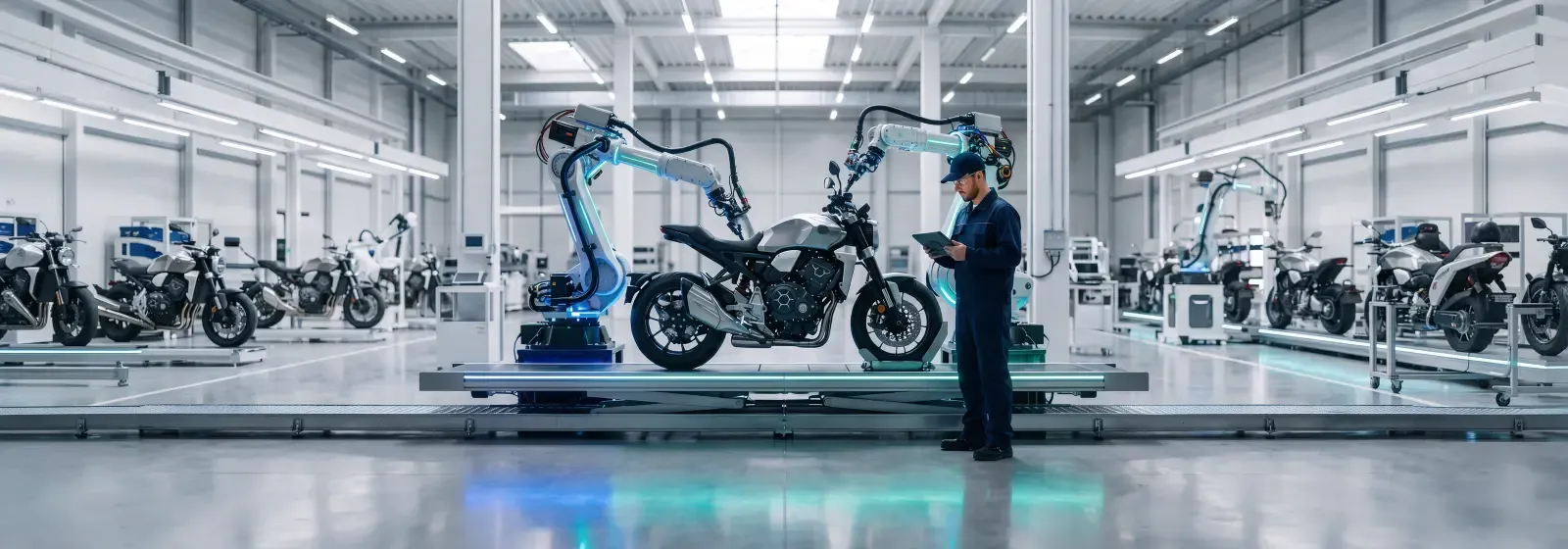
- 15 min Cost inflation impact analysis for 30,000+ parts
- 1,920 Man-hours saved
- 100% Costing data centralized
- 30,000+ Parts covered by each analysis
The context
Client and industry
The client is the largest two-wheeler (bike) manufacturer in the world.
Being the largest in its market comes with a heavy responsibility for cost discipline. To scale production and reach its next stage of growth, the company had to find efficiency in every manufacturing process, and costing was the most critical gap.
- Industry: automotive, two-wheeler manufacturing
- Position: the largest bike manufacturer in the world
- Existing systems: SAP ERP, already deployed across its manufacturing facilities
- Deployment: Cost It Right on-prem, as a bridge solution alongside SAP
The problem
The challenge
Micro-level costing was a manual job that took days and was prone to errors.
Despite using various ERP software, the costing team spent days on micro-level costing and on feeding the approved data into the system. Thousands of data points depended on manual work, so errors were almost certain.
Critical cost data across all manufacturing facilities was scattered, decentralized and not synced. That stopped the company from using its cost data for future growth initiatives. Cost visibility was scarce at the macro level and cost control was not streamlined.
The same manual process sat behind every cost inflation impact analysis. When input costs moved, working out the effect on tens of thousands of parts meant going back through the same spreadsheets and data entry. For a wider view of this problem, see why raw material cost change is hard to manage.
Why existing methods fell short
SAP held the approved figures but not the micro-level costing behind them, and the manual process around it created five problems:
- No real-time alerts on cost drivers or when a cost threshold limit was breached
- Error-prone manual processes that took undue time and resources
- No uniformity in data, so valuable time was lost extracting insights
- No centralized data, which hampered analytics and the study of future cost trends
- No micro-level costing data in SAP, which hampered cost reduction planning
Adding more people or more spreadsheets would not have fixed any of these. The company needed micro-level costing to happen in a system, with one central copy of the data, connected to the ERP it already ran.
The turning pointCost It Right (CIR)
The solution
How Cost It Right solved it
Cost It Right (CIR) by Softude automated the client's entire cost management process on an on-prem platform connected to SAP ERP.
CIR is a cost automation and control platform. Here it acted as a bridge solution and integrated with the SAP ERP the client already used, so the existing system stayed in place while CIR took over the micro-level costing.
- The team now runs a range of what-if scenarios and applies delta changes in a few clicks
- The entire repository of costing data is centralized in one place
- That central data now supports predictive analytics, procurement and vendor management, and strategy-driven cost reduction
Why a bridge alongside SAP instead of replacing it: SAP was already deployed across the client's facilities and held the approved figures the business ran on. What it lacked was the micro-level costing behind those figures. Adding CIR as a bridge kept SAP as the system of record, avoided a disruptive ERP replacement and filled the exact gap: detailed, automated costing connected to the ERP.
Rollout: CIR was deployed on-prem at the client and integrated with its SAP ERP.
Problem, CIR capability and result
| Problem | CIR capability used | Result |
|---|---|---|
| Error-prone manual costing that took days | End-to-end cost automation, what-if cost simulation | Cost inflation impact analysis of 30,000+ parts in 15 minutes, saving 1,920 man-hours |
| No uniformity in data | Centralized costing data | 100% of costing data centralized on one platform |
| No centralized data for analytics and cost trends | Centralized costing data | Central data now used for predictive analytics, procurement and vendor management |
| No micro-level costing data in SAP | ERP and SAP integration | Micro-level costing connected to SAP ERP, supporting strategy-driven cost reduction |
The impact
Results and business impact
Cost inflation impact analysis for more than 30,000 parts now takes 15 minutes, saving 1,920 man-hours.
| Measure | Before | After |
|---|---|---|
| Cost inflation impact analysis | Days of manual costing and data entry | 15 minutes for 30,000+ parts |
| Man-hours | Spent on manual micro-level costing | 1,920 man-hours saved |
| Costing data | Scattered and not synced across facilities | 100% centralized |
- End-to-end cost automation built a secure costing ecosystem and saved substantial enterprise resources, time and money
- 100% of costing data is centralized, forming a strong base for data intelligence
- What-if scenarios and delta changes now take a few clicks instead of a manual rebuild
The client now works in an end-to-end automated costing ecosystem that provides easy, quick and reliable cost automation and control.
Key takeaways
- Micro-level costing done by hand next to an ERP does not scale: thousands of manual data points make errors almost certain.
- An on-prem costing platform can work as a bridge alongside SAP ERP instead of replacing it.
- Centralizing all costing data turns it into a base for predictive analytics, procurement and vendor management.
- With automated what-if scenarios, a cost inflation impact analysis across 30,000+ parts becomes a 15-minute task.
Your playbook
How to replicate this
- 1. Map where costing happens outside the ERP today, and which costing detail SAP is missing
- 2. Deploy a costing platform as a bridge alongside SAP instead of replacing the ERP
- 3. Move micro-level costing out of spreadsheets so every part is costed in one system
- 4. Centralize the costing data from every facility in one repository
- 5. Use what-if scenarios to run cost inflation impact analysis across the full part base
- 6. Feed the central data into procurement, vendor management and cost reduction planning
Under the hood
Cost It Right capabilities
Used in this case study
The full story
See the full case study in detail
Get the complete case study as a PDF. Enter your work email and it opens straight away.
Keep reading
Related case studies
From the blog
Related reading
- ArticleThe Challenges of Managing Raw Material Cost Change EffectivelyDiscover proven strategies to manage raw material cost changes effectively in manufacturing. Our resources provide valuable insights and practical advice on how to optimize procurement, enhance supply chain efficiency, and drive growth in the face of fluctuating raw material prices.Read the article
- ArticleImpact of Cost Data Standardization on Your BusinessCost data standardization is a critical aspect of business operations that often goes overlooked. In today’s fast-paced and data-driven world, having consistent and standardized cost data is essential for driving growth and performance. %Read the article
- ArticleHow AI is Revolutionizing the Manufacturing Industry: Benefits and Use CasesHow AI is transforming the manufacturing industry and learn about the challenges and opportunities it presents. Our comprehensive guide covers everything from the basics of AI in manufacturing to advanced applications and strategies for success.Read the article
Good to know
Frequently asked questions
Micro-level costing works out the cost of a product from its smallest elements, such as each part's material, process, labour and overheads, instead of using averages. It shows exactly where cost sits and how a price change flows through to every part. Cost It Right (CIR) by Softude automates it, so costing that took days by hand runs in one system linked to SAP.
Yes. In this case study, Cost It Right was deployed on-prem as a bridge solution and integrated with the SAP ERP the client already used. SAP stayed the system of record, and CIR handled the micro-level costing that SAP did not hold.
Cost inflation impact analysis calculates how a rise in input costs, such as raw material prices, changes the cost of every affected part and product. Manufacturers need the answer quickly to revise prices, negotiate with suppliers and protect margins. With CIR, this client runs it for 30,000+ parts in 15 minutes.
For this client, cost inflation impact analysis of more than 30,000 parts takes 15 minutes with Cost It Right, saving 1,920 man-hours.
No. Cost It Right was deployed on-prem as a bridge solution and integrated with the SAP ERP the client already used.
Thousands of manual data points made errors likely, cost data was scattered across facilities and not synced, there were no real-time alerts on cost drivers or threshold breaches, and SAP had no micro-level costing data for cost reduction planning.
The team runs what-if scenarios and applies delta changes in a few clicks, and uses its centralized costing data for predictive analytics, procurement and vendor management, and strategy-driven cost reduction.
100% of the client's costing data is centralized in Cost It Right, forming a base for data intelligence.