Table of Contents
The Real Problem Is Not Lack of Data
What Is Centralized Data for Manufacturing CFOs?
Why Centralized Data Matters for Manufacturing CFOs
What Happens When Manufacturing Data Is Scattered?
Scattered Data vs Centralized Data
How Centralized Data Helps CFOs Decide Faster
CFO Decision Areas Improved by Centralized Data
Why Dashboards Alone Are Not Enough
How Centralized Data Supports Cost Simulation
What Data Should Manufacturing CFOs Centralize First?
The Centralized Data Framework for Manufacturing CFOs
Role of AI in Centralized Manufacturing Data
How Connected Costing and Procurement Systems Help
Conclusion
FAQ
Quick Answer
Centralized data for manufacturing CFOs helps finance leaders make faster and more accurate decisions by connecting cost, procurement, supplier, RFQ, operational, and financial data into one trusted view.
Instead of waiting for reports from multiple teams, CFOs can see cost movement, margin impact, supplier changes, procurement approvals, and product-level profitability in one place.
In manufacturing, this matters because even a small change in raw material price, freight, packaging, supplier quote, or process cost can directly affect margins.
The Real Problem Is Not Lack of Data
Manufacturing CFOs already have data.
The problem is that the data is rarely connected.
Costing may have one version of the cost. Procurement may have another supplier quote. ERP may show purchase history. RFQ details may sit in spreadsheets. Cost amendments may be tracked through emails. Finance may only see the final impact after the decision is already approved.
This is where decision-making slows down.
A CFO may ask a simple question:
Will this supplier decision affect margin?
But the answer may need inputs from costing, procurement, finance, supplier records, purchase history, RFQs, and approvals.
By the time everything is collected, checked, and discussed, the decision has already moved forward.
That delay is expensive.
What Is Centralized Data for Manufacturing CFOs?
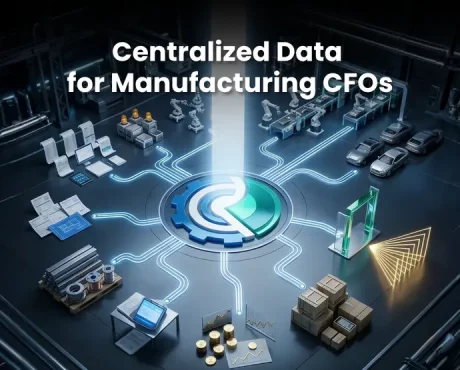
Centralized data for manufacturing CFOs means creating one trusted source of financial, costing, procurement, supplier, RFQ, and operational data.
It connects the information CFOs need to understand the real cost impact of business decisions.
This includes:
- BOM data
- Raw material prices
- Supplier quotations
- RFQ history
- Purchase history
- Should-cost models
- Cost amendments
- Packaging cost
- Freight cost
- Tooling cost
- Process cost
- Approval history
- Product-level margin data
The purpose is not just to store data in one place.
The real purpose is to help CFOs make faster, clearer, and more cost-aware decisions.
Why Centralized Data Matters for Manufacturing CFOs
Manufacturing CFOs are no longer responsible only for reporting numbers.
They are expected to protect margins, support pricing decisions, control costs, review procurement impact, improve forecasting, and reduce business risk.
All of this depends on one thing: trusted data.
When data is scattered, CFOs spend more time verifying numbers than making decisions.
When data is centralized, the same CFO can quickly see:
- What changed?
- Where did the cost increase come from?
- Which product margin is affected?
- Which supplier decision created the impact?
- Is the approval financially safe?
- What should be done next?
That is the real value of centralized data.
It turns finance from a reporting function into a decision function.
What Happens When Manufacturing Data Is Scattered?
Scattered data creates slow decisions, weak visibility, and hidden margin risk.
In many manufacturing companies, these problems are common:
- Finance works with delayed reports
- Procurement compares supplier quotes manually
- Costing teams manage data in spreadsheets
- RFQ history is not connected to approvals
- Cost amendments are tracked separately
- Supplier revisions are difficult to trace
- Product-level profitability is reviewed too late
- Different teams use different versions of cost
The result is not only inefficiency.
The bigger issue is decision risk.
A supplier quote may look acceptable because freight is missing.
A price approval may look safe because packaging is not considered.
A product may look profitable because the latest material cost has not been updated.
This is how margin leakage starts.
Scattered Data vs Centralized Data
| Scattered Data | Centralized Data |
|---|---|
| Multiple versions of cost | One trusted cost view |
| Manual report consolidation | Faster reporting and review |
| Delayed cost visibility | Real-time cost visibility |
| Slow procurement approvals | Faster approval decisions |
| Limited product-level margin view | Clear product-level profitability |
| Reactive cost control | Proactive cost decisions |
| Decisions based on assumptions | Decisions based on connected data |
How Centralized Data Helps CFOs Decide Faster
1. It improves cost visibility
In manufacturing, cost is not just raw material.
A complete cost view may include:
- Raw material
- Conversion cost
- Process cost
- Packaging
- Freight
- Tooling
- Overhead
- Rejection
- Supplier margin
When these elements are scattered, CFOs cannot see the complete picture quickly.
Centralized data helps CFOs understand the full cost structure. They can see what changed, why it changed, and how it affects the final product margin.
This makes decision-making faster and more accurate.
2. It speeds up procurement approvals
Procurement approvals often move slowly because finance does not get complete cost context.
A supplier may appear cheaper at the quote level. However, after adding freight, packaging, tooling, rejection risk, payment terms, and delivery impact, the same supplier may not be the best choice.
Centralized data helps CFOs review procurement decisions with total cost visibility.
This means approvals are not based only on supplier price. They are based on real cost impact.
3. It protects product-level margins
Margin leakage often starts with small changes.
For example:
- Raw material price increases
- Supplier revises a quote
- Freight cost changes
- Packaging cost is added separately
- Tooling cost is missed
- Process cost changes
- Rejection cost increases
Each change may look small in isolation.
But when connected to the final product cost, the impact can be serious.
Centralized data helps CFOs detect these changes earlier and protect margins before the issue becomes bigger.
4. It improves pricing decisions
Pricing decisions become risky when cost inputs are outdated.
If material cost, supplier price, packaging, or logistics cost changes, the CFO needs to know whether the selling price still protects margin.
Centralized data gives CFOs updated cost visibility before pricing decisions are finalized.
This reduces the risk of underpricing and helps protect profitability.
5. It improves forecasting and budgeting
Forecasting is weak when finance, procurement, and costing data are disconnected.
Centralized manufacturing data helps CFOs build forecasts using updated cost drivers, supplier trends, purchase history, RFQ data, and product-level impact.
As a result, budgets become more realistic.
More importantly, CFOs can update forecasts faster when market conditions change.
6. It reduces dependency on Excel
Excel is useful. But it should not become the main decision system for manufacturing finance.
When important decisions depend on multiple spreadsheets, three problems appear:
- Manual errors
- Delayed updates
- No single source of truth
Centralized data reduces this dependency by giving CFOs structured, updated, and connected information.
This does not remove Excel completely. It simply stops Excel from becoming the only source of decision truth.
CFO Decision Areas Improved by Centralized Data
| CFO Decision Area | Without Centralized Data | With Centralized Data |
|---|---|---|
| Pricing | Based on delayed cost inputs | Based on latest cost impact |
| Procurement approvals | Based mainly on supplier quote | Based on total cost comparison |
| Forecasting | Built from scattered reports | Built from trusted cost data |
| Cost control | Leakage found late | Leakage flagged early |
| Margin review | Product-level view is limited | Product-level profitability is clear |
| Supplier decisions | Price-focused | Cost-impact focused |
| Budgeting | Based on disconnected inputs | Based on connected cost drivers |
Why Dashboards Alone Are Not Enough
Many companies already have dashboards.
But dashboards do not always solve the problem.
A dashboard shows information. Centralized data creates trust in that information.
If a dashboard is built on incomplete, outdated, or disconnected data, it only confuses visually.
Manufacturing CFOs do not need more charts.
They need reliable cost, procurement, supplier, and margin data connected at the point of decision.
That is the difference between reporting visibility and decision visibility.
How Centralized Data Supports Cost Simulation
Reports show what happened.
Simulation helps CFOs understand what could happen next.
This is where centralized data becomes powerful.
With connected data, CFOs can simulate questions such as:
- What happens if the raw material cost increases by 5%?
- What happens if Supplier A replaces Supplier B?
- What happens if freight costs increase?
- What happens if the packaging cost is separated?
- What happens if RFQ volume changes?
- What happens if a cost amendment is approved?
- What happens if a supplier’s quote excludes tooling?
- What happens if rejection cost increases?
These questions are difficult to answer when data is scattered across systems.
However, when costing, procurement, supplier, and product data are centralized, CFOs can see the financial impact before approving decisions.
This is the shift from reporting to decision intelligence.n for better decision-making across procurement.
What Data Should Manufacturing CFOs Centralize First?
CFOs do not need to centralize everything on day one.
They should start with the data that directly affects cost, margin, and approvals.
The most important data includes:
- BOM data
- Raw material rates
- Supplier quotations
- RFQ records
- Purchase history
- Should-cost models
- Process costs
- Freight cost
- Packaging cost
- Tooling cost
- Cost amendment records
- Supplier revision history
- Approval workflows
- Product-level margin data
Once these data points are connected, CFOs gain a clearer view of cost movement and decision impact.
The Centralized Data Framework for Manufacturing CFOs
Manufacturing CFOs can think of centralized data in five layers.
1. Data capture
This includes supplier quotes, RFQs, cost sheets, purchase history, BOMs, amendments, and approvals.
2. Data standardization
Different teams may record the same data differently. Centralization requires a common structure for cost heads, supplier names, materials, parts, and product codes.
3. Cost visibility
Once data is standardized, CFOs can see cost movement across material, process, packaging, freight, tooling, and supplier pricing.
4. Decision simulation
CFOs can test different scenarios before approving pricing, supplier changes, amendments, or sourcing decisions.
5. Decision control
The final layer is workflow. Decisions should be approved with full cost impact, not only with partial reports.
This framework helps CFOs move from scattered reporting to controlled decision-making.
Role of AI in Centralized Manufacturing Data
AI can help CFOs make faster decisions, but only when the data foundation is clean and connected.
If data is scattered, AI only creates faster confusion.
With centralized data, AI can help CFOs:
- Extract data from PDFs, emails, and spreadsheets
- Identify missing cost elements
- Detect supplier price anomalies
- Find procurement cost leakage
- Generate reports faster
- Compare scenarios
- Highlight margin risks
- Support cost simulation
AI does not replace CFO judgment.
It improves decision speed by making cost signals easier to identify.
How Connected Costing and Procurement Systems Help
Connected costing and procurement systems reduce the gap between data and decisions.
They bring together:
- Costing data
- Procurement data
- RFQ data
- Supplier data
- Amendment data
- Approval data
This gives CFOs better visibility into supplier decisions, cost movements, and product-level profitability.
Platforms like Cost It Right help manufacturing companies centralize costing, procurement, RFQ, supplier, and amendment data into one workflow. This helps CFOs review cost impact, compare supplier decisions, and protect margins before approvals are finalized.
Conclusion
Centralized data is not just an IT improvement.
For manufacturing CFOs, it is a decision-speed advantage.
When data is scattered, finance reacts late. When data is centralized, CFOs can see cost impact earlier, review approvals faster, and protect margins more effectively.
The shift is clear.
Manufacturing CFOs need to move from delayed reporting to real-time cost visibility.
They need to move from scattered data to connected decisions.
The CFO who sees cost impact earlier can act earlier.
FAQ
Centralized data for manufacturing CFOs is a single trusted view of finance, costing, procurement, supplier, RFQ, and operational data used to make faster cost and margin decisions.
Centralized data helps manufacturing CFOs improve cost visibility, reduce data silos, speed up approvals, review supplier impact, and protect product-level margins.
Manufacturing CFOs need centralized data because cost, procurement, supplier, and margin decisions depend on accurate and connected information.
It connects cost drivers such as material, process, supplier pricing, packaging, freight, tooling, and amendments so CFOs can see the complete financial impact.
Manufacturing CFOs should centralize BOM data, supplier quotes, RFQ records, purchase history, raw material prices, should-cost models, cost amendments, and product-level margin data.
AI helps CFOs extract data, detect anomalies, identify cost leakage, generate reports, compare scenarios, and highlight margin risks when the underlying data is clean and connected.
Yes. A dashboard shows information, but centralized data creates one trusted source behind that information. Without clean and connected data, dashboards can still show incomplete or outdated numbers.