Table of Contents
What is Should-Cost Analysis in Procurement?
Why is Should-Cost Analysis Important?
How to do Should-Cost Analysis?
What Does Should-Cost Include?
Example of Should-Cost Analysis
Benefits of Should-Cost Analysis
Challenges in Should-Cost Analysis
How AI Improves Should-Cost Analysis
How Should-Cost Analysis is Used in Procurement
Without vs With Should-Cost Analysis
Role of Technology in Should-Costing
Conclusion
FAQ
Should-cost analysis in procurement helps manufacturers estimate the true cost of a product before evaluating supplier quotations. However, many procurement teams still rely only on supplier pricing, which leads to weak negotiation and hidden cost gaps.
In many cases, decisions are based on quotes rather than cost understanding. This leads to higher spending and hidden cost leakage.
This is where the should-cost analysis becomes important.
Instead of relying only on supplier pricing, manufacturers can estimate the ideal cost of a product before making a decision.
What is Should-Cost Analysis in Procurement?
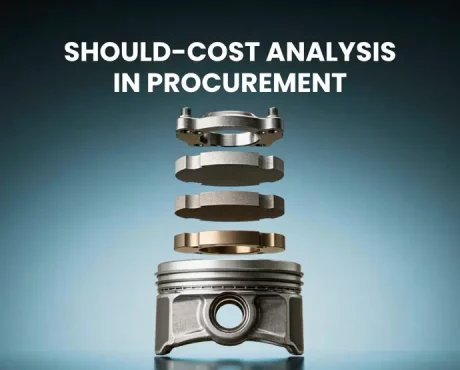
Should-cost analysis in procurement is the process of estimating the ideal cost of a product based on materials, processes, labor, overheads, and market benchmarks to evaluate supplier quotes and support better sourcing decisions.
In simple terms, it answers one key question:
What should this product actually cost?
Why is Should-Cost Analysis Important?
Should-cost analysis helps procurement teams move from price-based decisions to cost-based decisions.
Without it:
- Every supplier quote appears acceptable
- Negotiation lacks direction
- hidden costs go unnoticed
However, with should-cost analysis:
- Procurement teams gain a cost benchmark
- Supplier quotes can be evaluated objectively
- Negotiation becomes data-driven
As a result, organizations improve cost control and reduce unnecessary spending.
How to do Should-Cost Analysis?
Should-cost analysis follows a structured approach.
Step 1: Understand the product or component
The process begins with understanding the design, material requirements, and manufacturing method.
Step 2: Identify cost drivers
Key cost elements are identified, such as:
- raw materials
- manufacturing processes
- labor
- overhead
Step 3: Estimate material cost
Material cost is calculated based on:
- quantity required
- market price
- material type
Step 4: Calculate process cost
Manufacturing processes such as machining, molding, or assembly are analyzed to estimate process costs.
Step 5: Add overhead and indirect costs
Costs such as:
- factory overhead
- energy
- maintenance
are included.
Step 6: Include packaging, freight, and margin
Additional elements like logistics, packaging, and supplier margin are added to complete the model.
Step 7: Build the final should-cost model
All cost components are combined to estimate the total cost.
Also read- How to Do Should-Cost Analysis Step by Step
What Does Should-Cost Include?
A complete should-cost model includes:
- Raw material cost
- Process cost
- Labor cost
- Overhead
- Packaging
- Freight
- Tooling (if applicable)
- Rejection or scrap cost
- Supplier margin
This ensures full cost visibility before comparing supplier quotes.
Example of Should-Cost Analysis
Consider a manufacturing component:
| Cost Element | Value |
|---|---|
| Raw Material | 50 |
| Process Cost | 15 |
| Overhead | 10 |
| Packaging & Freight | 5 |
| Supplier Margin | 5 |
| Total Should-Cost | 85 |
Now, if a supplier quotes 100, there is a gap of 15.
This gap becomes a clear negotiation opportunity.
Instead of guessing, procurement teams can challenge specific cost elements.
Benefits of Should-Cost Analysis
Should-cost analysis provides several advantages.
- Improves negotiation with suppliers
- Creates cost transparency
- Enables better supplier comparison
- Reduces cost leakage
- Supports data-driven decisions
More importantly, it helps organizations move from reactive procurement to proactive cost control.
Challenges in Should-Cost Analysis
Despite its benefits, many organizations struggle to implement should-cost analysis effectively.
Common challenges include:
- Lack of accurate data
- High manual effort
- Limited expertise in cost modeling
- Difficulty in maintaining updated benchmarks
- Disconnected systems across costing and procurement
Because of these challenges, many teams rely only on supplier quotes.
How AI Improves Should-Cost Analysis
AI is transforming how should-cost analysis is performed.
Instead of manual calculations, AI enables faster and more accurate cost modeling.
AI can:
- Extract cost data from drawings and documents
- Build cost models automatically
- Benchmark against historical data
- Detect anomalies in supplier pricing
- Simulate cost changes
As a result, procurement teams can generate should-cost estimates quickly and use them in real-time decisions.
How Should-Cost Analysis is Used in Procurement
Should-cost analysis is not limited to cost estimation. It plays a key role in procurement decisions.
It is used for:
- evaluating supplier quotations
- identifying overpriced quotes
- supporting RFQ comparison
- guiding supplier negotiations
- making cost-based approvals
Therefore, should-cost becomes a foundation for better decision-making across procurement.
Without vs With Should-Cost Analysis
| Without Should-Cost | With Should-Cost |
|---|---|
| Supplier-driven pricing | Data-driven pricing |
| Weak negotiation | Strong negotiation leverage |
| Limited cost visibility | Full cost breakdown |
| Higher cost risk | Controlled cost decisions |
Role of Technology in Should-Costing
Modern procurement platforms integrate should-costing with sourcing workflows.
These systems help teams:
- Build cost models
- Compare supplier quotes
- Track cost changes
- Simulate cost impact
Platforms like Cost It Right bring costing, RFQ analysis, and supplier evaluation into one system, enabling better procurement decisions with full cost visibility.
Conclusion
Should-cost analysis is no longer optional in modern procurement.
Without it, decisions rely on supplier pricing.
With it, decisions are based on cost understanding.
As manufacturing becomes more complex and cost pressures increase, the ability to estimate and validate costs before procurement decisions becomes critical.
The shift is clear:
From price-based decisions → to cost-driven decisions
From guesswork → to structured cost analysis
FAQ
It is the process of estimating the ideal cost of a product to evaluate supplier quotes and support better sourcing decisions.
It is calculated by combining material, process, labor, overhead, logistics, and margin costs.
It helps procurement teams negotiate better, compare suppliers accurately, and control costs.
Cost drivers include materials, processes, labor, overhead, and logistics.
AI automates cost modeling, benchmarks pricing, detects anomalies, and enables faster and more accurate cost estimation.